
Versatility in the workplace refers to an employee’s ability to hold multiple positions or perform different types of tasks within their company. It contrasts with strict specialization, in which each person holds a single position.
In the industry, the term has a specific meaning. A versatile operator can replace a colleague in another position by meeting all the requirements of that position, including the necessary skills and authorizations.
This article defines the concept, its forms, and its legal framework, and then examines it in light of the facts: surveys on working conditions conducted by DARES, case law, ergonomic research, and twelve months of data from 210 industrial sites equipped with Mercateam.
🎯 Request a free demo of Mercateam software
What is versatility in the workplace?
Job versatility is an employee’s ability to work in multiple positions, operate various machines, or handle different stages of a process. It combines the specific skills required for each position with the ability to adapt from one context to another.
It takes the opposite approach to the model described by Frederick Taylor in The Principles of Scientific Management (1911), which assigned each worker a single, broken-down, and timed task.
The Toyota Production System has made this an organizational principle. In it, Taiichi Ohno describes workers who operate several different machines on the same production line, which makes it possible to adjust the number of workers to the volume to be produced.
Operational Definition
An operator is versatile when they cover 100 % requirements for at least two distinct positions : skills assessed at the operational level and valid clearances. All Mercateam figures in this article are based on this definition.
Why count requirements rather than positions filled?
On average, a production workstation has 3.73 requirements in the pharmaceutical industry and 7.20 in the automotive industry. An operator who meets six out of seven of these requirements can work there every day without having mastered the workstation in terms of compliance.
The discrepancy comes to light during a quality audit or inspection: the position is filled, but by someone who lacks the necessary qualifications. The kind of versatility that is valuable to the company is the kind that stands up to this scrutiny.
Is versatility a skill?
Yes, it is a cross-functional skill that combines technical expertise, interpersonal skills, and the ability to adapt. In the workshop, however, it is demonstrated through the requirements of each position.
Forms of Versatility and How It Differs from Multiskilling
The term encompasses several different concepts. Distinguishing between them makes it possible to develop coherent competency matrices and set specific training objectives.
| Concept | What it refers to | Workshop Example | What it secures |
|---|---|---|---|
| Horizontal Versatility | Several positions with the same level of complexity | One operator trained on three machines on a packaging line | Replacing an Absent Colleague |
| Vertical Versatility | Tasks of varying difficulty levels within the same scope | A line operator who also performs adjustments and preliminary fault diagnostics | Responsiveness to Incidents |
| Multidisciplinary Skills | Expertise drawn from various fields | An operator that manufactures and provides first-level maintenance | Uninterrupted service without the need for support |
| Cross-functional skill | A skill that is useful in many situations | Reading blueprints, 5S, problem-solving | Adapting to a new position, though not enough to keep it |
Vertical mobility remains the least accessible to workers. According to the survey 2019 Working Conditions Report by Dares, 53 % of unskilled workers are unable to resolve incidents on their own, compared to 32 % of all employees.
The border with the multi-skilling structures the breakdown of reference frameworks: a production position and a maintenance task do not fall under the same matrix line.
What is a versatile skill?
It is a skill that can be applied in a variety of contexts, such as problem-solving or mastering a digital tool. It remains useful across different roles, though it does not, on its own, constitute mastery of a position.
The Legal Framework for Versatility in France
The Labor Code does not define “versatility.” Its legal framework stems from the employer’s managerial authority, case law regarding contract modifications, and training obligations.
- Change roles within one's field of expertise. A different task, «as long as it corresponds to the employee’s qualifications,» does not alter the employment contract (Court of Cassation, Labor Division, May 10, 1999, No. 96-45.673).
- Advance from the qualifying round. Assignment to duties corresponding to a different job classification constitutes a modification of the employment contract and requires the employee’s consent.
- Match employees to their positions. Article L6321-1 of the Labor Code requires employers to make these accommodations and to ensure that employees remain able to perform their jobs.
- Reward versatility. No bonus is required by law. It may be provided for in a collective bargaining agreement, a company-wide agreement, or a contract clause.
L'1999 ruling The case involved a farmworker who had switched from picking lemons to bundling bananas. Although the tasks had changed, the job classification remained the same: the Court viewed this as a mere change in working conditions.
Describing the requirements of each position in detail thus helps to objectively determine what does—or does not—constitute an employee’s qualifications when assigning them to a position.
How many operators are truly versatile?
We applied the strict definition to 210 French industrial sites, representing 59,298 employees who were monitored for twelve months. The median per site was 12.5 % of versatile operators.
Depending on the sector, 80 to 90 % of workers hold a single position. The breakdown of the others provides insight into how versatility is developed.
How many positions does an operator actually master?
Breakdown of operators in each sector by the number of positions for which they meet all requirements.
A threshold rather than a steady increase
The two-shift schedule has the fewest workers. In the agri-food industry, 1.0 % of operators work this schedule, compared to 5.4 % in four-shift or longer schedules. In the pharmaceutical industry, the range varies from 2.4 % to 12.2 %.
There are two reasons for this. The job requirements overlap between similar positions, so the third position can be filled more quickly than the second. And the operator who is already versatile is the first to be called upon for substitutions.
The automotive sector is an exception, with 13.8 % operators working two shifts and none working more than three. The rhythmic production line standardizes movements enough to make a second shift feasible, without creating a need for a fourth.
Organization matters more than the sector
The table shows the median rate by sector and its variation across sites. The first quartile corresponds to the least versatile sites, and the third quartile to the most versatile.
| Sector | Sites | Median rate per site | First quartile | Third quartile | Job Requirements |
|---|---|---|---|---|---|
| Cosmetics | 9 | 20.1 1Q3Q | 7.1 1Q3Q | 34.2 1Q3Q | 4,57 |
| Aeronautics | 31 | 16.8 1Q3Q | 3.3 1Q3Q | 36.6 1Q3Q | 5,78 |
| Automotive | 28 | 14.9 1Q3Q | 0.8 1Q3Q | 67.4 1Q3Q | 7,20 |
| Pharmaceuticals | 12 | 14.6 1Q3Q | 0 % | 33.7 1Q3Q | 3,73 |
| Food industry | 18 | 10.1 1Q3Q | 1.1 1Q3Q | 32.6 1Q3Q | 5,12 |
What sets sites apart, therefore, comes down to how they assign, develop, and track skills. A sector-wide average provides little insight into the situation at a given site.
Why Companies Are Promoting Versatility
Work has become more variable. According to the Dares Working Conditions Surveys, the proportion of employees who often have to interrupt a task to perform an unplanned one rose from 48 % in 1991 to 65 % in 2019.
The proportion of employees whose work schedule is influenced by at least three factors rose from 5 % in 1984 to 34 % in 2019. Among skilled workers, it reached 56 %.
The job market reflects this expectation: On August 26, 2026, Indeed France listed more than 19,000 job postings for the search term «multi-skilled employee.».
On the shop floor, Industry 4.0 is driving this need. Production lines that are reconfigured more frequently require teams capable of moving from one workstation to another as production changes.
At the industrial site level, this variability is reflected in three figures:
At a site with 200 operators, an absenteeism rate of 5 % means that about ten people are missing each day. Every absence requires reassigning someone, and the operator’s versatility determines whether that replacement is qualified.
What She Brings to the Company
- Production continuity. Absences and peaks in activity are accommodated without line stoppages or systematic reliance on overtime.
- Less reliance on experts. 97 % of the sites in our panel have at least one skill held by a single person who is at risk of leaving or being laid off.
- Team compliance. Putting together a fully qualified team for a NADCAP audit or a GMP inspection requires having multiple qualified individuals for each position.
For the manufacturing companies we serve, digital skills tracking saves up to one day per week in scheduling and reduces on-the-job training time by a factor of four.
At Trigano VDL, efforts to promote versatility have resulted in 40 fewer % instances of production line slowdowns due to employee absences.
Collins Aerospace, Bonduelle, Guerlain, and Saint-Gobain are also among the manufacturers leveraging their versatility with Mercateam.
What it offers employees
- A more varied job. Job rotation provides biomechanical and psychosocial variety, provided that the positions are designed appropriately (see the limitations below).
- Enhanced employability, both within and outside the company, which is precisely what the adaptation requirement under Article L6321-1 is intended to uphold.
- A Possible Recognition through a bonus, a change in classification, or a career path, when provided for by an agreement or a collective bargaining agreement.
This last point should be addressed before any development plan is drawn up. Demanding versatility without offering anything in return places a burden on the most heavily utilized operators, who are also the ones whose departure would be the most costly.
The Cost of His Absence
A lack of versatility rarely brings a production line to a halt. It results in positions being filled by partially qualified workers, which is reflected in staffing data rather than in production metrics.
Percentage of positions filled by fewer than three people
Median per site. A position is filled when an operator meets all of its requirements.
In the automotive industry, 647 of the 1,156 positions identified have no operator who meets all of their requirements. Yet these positions are staffed every day by an employee who fails to meet at least one of the requirements.
Of the 3,651,583 assignments recorded over a 12-month period in our data from staff scheduling management, 523,745 relate to an employee who is not qualified for the position, or 14.3 %.
This rate rose from 11.25 % in August 2025 to 16.4 % in July 2026. A lack of versatility thus carries over into compliance: it does not appear in the TRS, but rather in the traceability of qualifications verified during audits.
The Limitations and Risks of Versatility
Four limitations emerge from the literature and our data: the discrepancy between reported and actual versatility, dispersion, training costs, and the health effects of a poorly designed rotation.
A reported versatility higher than the actual versatility
A versatility rate is only as reliable as the evaluations on which it is based. However, the proportion of operators evaluated within the last twelve months varies from one to five times, depending on the sector.
| Sector | Carriers rated within the last 12 months | Median versatility rate |
|---|---|---|
| Automotive | 54.1 1Q3Q | 14.9 1Q3Q |
| Aeronautics | 50.0 % | 16.8 1Q3Q |
| Food industry | 42.4 1Q3Q | 10.1 1Q3Q |
| Cosmetics | 24.8 1Q3Q | 20.1 1Q3Q |
| Pharmaceuticals | 11.1 1Q3Q | 14.6 1Q3Q |
The pharmaceutical and automotive sectors show similar ratios. The former is based on 11.1 % from recent valuations, while the latter is based on 54.1 %: the same figure does not have the same level of reliability.
The cosmetics category, which tops the rankings, is based on only a quarter of recent reviews, so its rating should be interpreted with caution.
Distraction and Overload
When promoted without proper evaluation, versatility leads an employee to take on multiple roles without developing expertise in any of them. It also concentrates flexibility among a minority: in the pharmaceutical industry, 12.2 % of operators hold four or more positions.
These operators become the workshop’s adjustment variable. Anticipation makes all the difference: a work assignment known the day before has less of an impact than a change announced at the start of the shift.
The balance between specialization and versatility is determined on a position-by-position basis. Some positions require a dedicated expert, while others benefit from having three people in the role. Prioritization and support from team leaders help prevent burnout.
Training Time and Cost
Each additional position represents a complete training program. The median duration of a completed program varies significantly by sector:
These timeframes cover the training process through to its completion, excluding waiting periods and on-the-job training.
The Effects of Rotation on Health
Job rotation is often presented as a means of preventing musculoskeletal disorders. Research in ergonomics clarifies the conditions under which it is effective.
On a ten-station oven assembly line, Gerling, Aublet-Cuvelier, and Aptel compared two rotation systems. The first had two positions that posed a high risk to the shoulder; the second had only one.
Their recommendations: redesign the most physically demanding workstations before implementing job rotation, and then alternate between heavy-duty and light-duty workstations to avoid repeated strain on the same body parts.
A paper presented at the 2012 SELF conference—based on research conducted in the aerospace industry—adds additional criteria: learning difficulties, quality issues, exposure profiles, and group dynamics.
How to Measure a Team's Versatility
The metric is based on three components: a set of job-specific requirements, a proficiency level scale, and a summary indicator calculated by site.
Assess proficiency using the ILUO rubric
Based on lean manufacturing principles, the ILUO grid evaluates each operator at each workstation according to four levels. The number of strokes in each letter indicates the level of proficiency.
| Level | What the operator can do | Item considered under control |
|---|---|---|
| I | Currently in training, is familiar with safety procedures, and works under supervision | No |
| L | Performs the operation under normal conditions, adheres to the cycle time, and detects defects | No, incomplete autonomy |
| U | Works independently, prepares for their shift, manages the startup process, and handles common issues | Yes |
| O | Trains other operators and suggests improvements | Yes |
In our data, the threshold used is the operational level, which is equivalent to autonomy in the position. An expired authorization revokes proficiency, regardless of the level achieved.
Calculate the versatility rate
Calculate it site by site, then consolidate the results using the median. An average can be skewed by a few extreme sites, which are common given the observed dispersion.
Next, interpret the result in light of the number of requirements per position. With fewer than four requirements, a high rate is easier to achieve; with more than seven, even a modest rate reflects a significant effort.
Supplementary Indicators
The rate alone does not identify vulnerabilities. Four indicators supplement it, along with benchmarks measured across our sample.
| Indicator | What it reveals | Measured reference point |
|---|---|---|
| Positions filled by fewer than three people | Exposure to Absences | 24.8 1Q3Q to 77.8 1Q3Q positions by sector |
| Skills possessed by a single person | Reliance on Experts | Median of 5 to 52 per site |
| Carriers rated within the last 12 months | The Reliability of the Versatility Rate | 11.1 1Q3Q to 54.1 1Q3Q by sector |
| Non-compliant assignments | The Shift of Risk to Compliance | 14.3 Q1-Q3 overall, ranging from 3.6 Q1-Q3 to 31.2 Q1-Q3 across sites |
Production indicators measure the effects of versatility, not versatility itself. When tracked over time, they show whether the gains in versatility are reflected in actual performance.
| Impact Indicator | What this conveys about versatility |
|---|---|
| Incident Response Time | The speed with which a qualified person can be mobilized in the event of an emergency |
| Task Turnover Rate | The actual frequency of job changes |
| Absenteeism rate | The ability to fill in for an absent employee without slowing down the production line |
| Error Rate | Proficiency in the positions held on an interim basis |
| Training Time | How quickly a new position is filled |
| Delivery time | The Effect of Substitutions on Production Flow |
| Employee satisfaction | Perceptions of Job Variety and Career Prospects |
| Customer Satisfaction | The ultimate impact on quality and timelines |
These measures are part of the follow-up to the industrial performance indicators.
What the competency matrix doesn't show
A traditional analysis of the matrix, operator by operator, leaves two blind spots: skills possessed by only one person and validated skills that no one has assigned to themselves.
Skills possessed by a single person
A skill held by a single active employee constitutes a monopoly. 105 of the 108 sector-specific sites in our sample have at least one such employee, or 97 % sites.
The median ranges from 5 monopolies per site in the agri-food industry to 52 in the aerospace industry, including 7 authorizations. Special processes and name-based authorizations significantly increase the number of entries in the reference document.
The cosmetics industry shows that these roles are distinct. No position in the industry is held by a single operator, but each site has a median of 9 roles held by a single person.
A position can therefore be filled by two people, while a specific skill set remains the responsibility of a single person. It is on these critical skills on which business continuity depends.
Skills that have been validated but never put to use
By cross-referencing operational-level evaluations with actual assignments over a 12-month period, we identified the skills that were never scheduled. Cross-functional skills are excluded from the calculation.
Percentage of validated skills that were never assigned within twelve months
Skills assessed at the operational level or higher, with no corresponding scheduling assignment.
The calculation applies only to employees who have had at least one actual assignment. Therefore, neither a long-term leave of absence nor a departure accounts for these discrepancies.
Education. Within the same workforce, up to half of the validated skills are never used, while 14.3 % of assignments go to unskilled employees. Some of the missing versatility already exists, but remains invisible at the time of assignment.
All your skills in one person, in one search
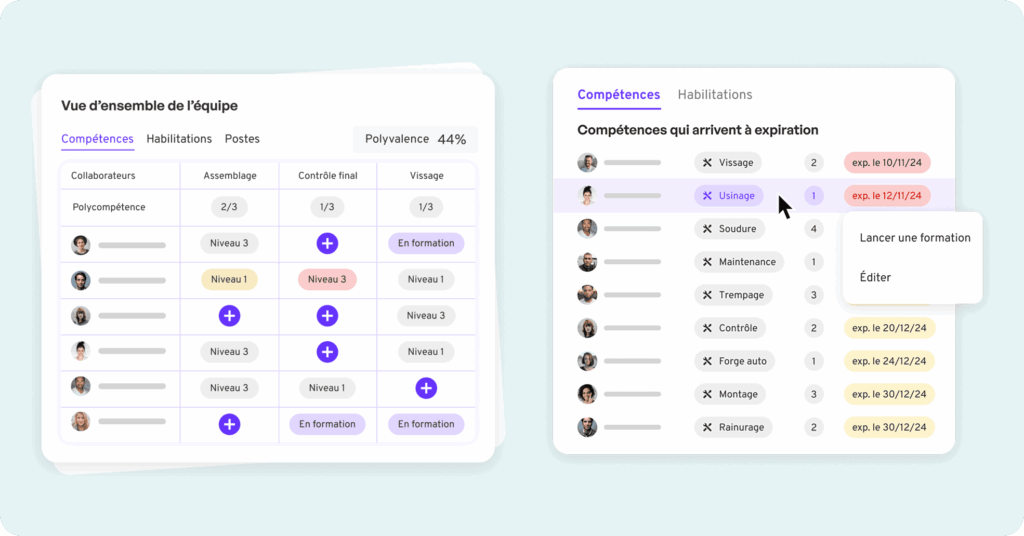
Based on your own data, the Mercateam matrix lists positions filled by fewer than three people, skills held by only one person, and validated skills that have never been assigned.
Book a demoWhat is versatility management?
It involves organizing, monitoring, and developing skills to allocate tasks and handle unforeseen circumstances. It relies on a competency matrix, targeted training, internal mobility, and assignments that take qualifications into account.
How to Foster Versatility in a Team
Versatility is something you build. It is based on a skills mapping existing skills, a structured training plan, and ongoing support—without which actual and perceived versatility become indistinguishable.
Three key factors emerge from the data: job rotation, cross-training, and tracking authorization renewal deadlines.
Job Rotation
Tenure data show the effect of turnover. Among temporary workers with between three and ten years of tenure, 43.4 % are versatile, compared with 31.8 % of permanent employees with the same tenure.
Temporary workers are assigned to wherever there are staff shortages and therefore rotate among different positions. Permanent employees remain in their own positions, precisely because they perform well there and moving them would weaken the workforce in the short term.
One rotation per quarter for each operator trained on a second workstation maintains that workstation and triggers a reassessment. It must comply with the ergonomic requirements described above.
Cross-training for the position
Cross-training builds on the skills already present within the team: an experienced operator teaches the procedures to a colleague and verifies that the colleague is ready to work independently. Its primary goal is to prepare employees to move to the second shift.
| Length of Service | Permanent Contract | Fixed-Term Contract | Temporary Work |
|---|---|---|---|
| Less than a year | 10.6 1Q3Q | 5.9 1Q3Q | 9.4 1Q3Q |
| 1 to 3 years | 23.5 1Q3Q | 13.5 1Q3Q | 21.1 1Q3Q |
| Ages 3 to 10 | 31.8 1Q3Q | 18.6 1Q3Q | 43.4 1Q3Q |
| 10 years and older | 32.9 1Q3Q | 8.9 1Q3Q | 3.8 1Q3Q |
For employees on permanent contracts, versatility increases from 10.6 % in the first year to 31.8 % between three and ten years, and then to 32.9 % beyond that. The last seven years account for only a 1.1-point increase.
Informal learning has the greatest impact during the first three years. Beyond that, progress depends on a individual development plan, to be scheduled around the third anniversary.
Tracking Authorization Deadlines
Versatility is also declining. Of the 23,269 operators tracked over a 12-month period, 12.8 % gained skills, 67.0 % remained stable, and 20.2 % lost skills.
| Sector | Employees Under Monitoring | Progress | Stability | Regression |
|---|---|---|---|---|
| Aeronautics | 9,501 | 16.2 1Q3Q | 56.7 1Q3Q | 27.1 1Q3Q |
| Food industry | 3,567 | 14.5 1Q3Q | 69.2 1Q3Q | 16.3 1Q3Q |
| Pharmaceuticals and Cosmetics | 7,049 | 10.8 1Q3Q | 75.2 1Q3Q | 14.0 1Q3Q |
| Automotive | 3,152 | 4.9 1Q3Q | 77.4 1Q3Q | 17.7 1Q3Q |
When a certification expires, coverage for the position is withdrawn, even though the procedure remains under control. Anticipating these expiration dates preserves versatility without the need for additional training, making it the least costly option.
The median time between two updates to an employee's profile is 49 days, and exceeds 118 days for one-quarter of employees. A skills matrix which alerts users to upcoming deadlines before expiration, reduces this gap.
Where to Start at an Industrial Site
The initial measurements are derived from the data already available, in the following order:
- Count the requirements for each position. Their average number provides the key to understanding the rate of polyvalence.
- List the positions filled by fewer than three people. These are the people who struggle when they're away for just a few days.
- Identify the skills possessed by a single person, starting with the individual authorizations.
- Cross-reference the matrix and the 12-month schedule to identify skills that have been validated but never assigned.
- Prioritize the transition from one position to two in the positions with the least coverage.
This final decision is based on the observed threshold: bringing in ten operators from one to two shifts further reduces exposure to absences than bringing in two operators from three to five shifts.
To create these lists using your own data, request a Mercateam demo.
Methodology and Sources
Mercateam's data comes from 210 French industrial sites equipped with the platform, representing 59,298 active employees, over a 12-month rolling period (August 2025 to August 2026).
- An operator is considered versatile if he or she meets 100 % of the requirements for two or more distinct positions: operational-level skills and valid certifications.
- Each rate is calculated by site and then consolidated into a median and quartiles. The sector-specific figures cover 98 sites (multipurpose) and 108 sites (specialized).
- Skill development involves 23,269 employees, and assignment compliance covers 3,651,583 assignments. Demonstration sites are excluded.
- This observation describes manufacturers using Mercateam and does not claim to represent the entire French manufacturing industry.
External sources:
- Dares, Surveys on Working Conditions, 1984–2019, and « Working Conditions and Exposure to Occupational Hazards », document for the COR, March 2023.
- Court of Cassation, Labor Chamber, May 10, 1999, No. 96-45.673. Labor Code, Article L6321-1.
- Gerling, A., Aublet-Cuvelier, A., Aptel, M., « Comparison of Two Job Rotation Systems for the Prevention of Musculoskeletal Disorders », PISTES magazine, 2003.
- St-Vincent, M., Denis, D., Imbeau, D., Gonella, M., et al., «Versatility: A Form of Organization with Multiple Implications,» 47th SELF Conference, Lyon, 2012.
- 2026 Social Performance Observatory, Ipsos BVA for Oasys and Diot-Siaci.
Striking the right balance between specialization and versatility
The balance between expertise and versatility is essential to maintain competitiveness and efficiency in an operational environment.