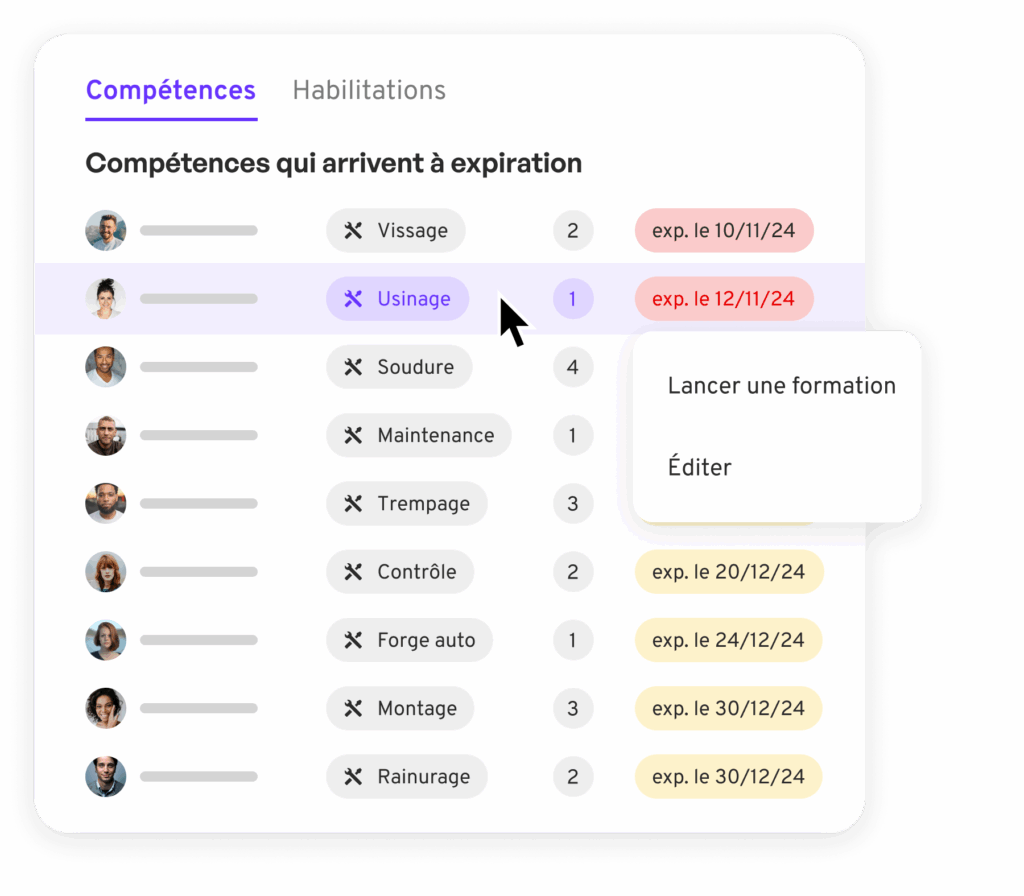

What is a skills matrix?
A skills matrix is a visual tableau that cross-reference team members (in rows) with required skills for their activities or positions (in columns). Each cell displays the level of expertise the employee's proficiency in the relevant skill, typically rated on a scale of 0 to 4. The result answers the following question: For each skill you need, who possesses it and at what level?
The tool is a operational photography at a given moment, used to set up a schedule, instruct a training course or prepare an audit. It doesn't replace the organization chart (which describes the hierarchy) or the job description (which describes the missions). It complements both by measuring what your teams really know how to do.
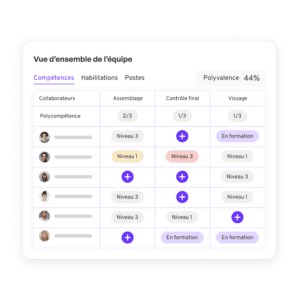
Example of a competency matrix
Two conditions must be met for the competency matrix to be effective:
- Involving employees in its construction and validation, or else we'll end up with an imposed document that managers will stop keeping up to date.
- Cover all significant activities of the service, to leave no grey area in the allocation of resources.
Explore a skills matrix in a video

What is the origin of the competency matrix?
The tool was born in the manufacturing industry with the quality initiatives of the 1980s (Training Within Industry, ISO 9000). It has become widespread wherever process control needs to be proven: production, services, healthcare, IT. It takes on its full value in environments with a high turnover of teams, subject to regulatory authorizations or with a variable proportion of temporary staff, where informal knowledge is no longer enough.
Discover the Mercateam platform with Competency and Empowerment Matrix.
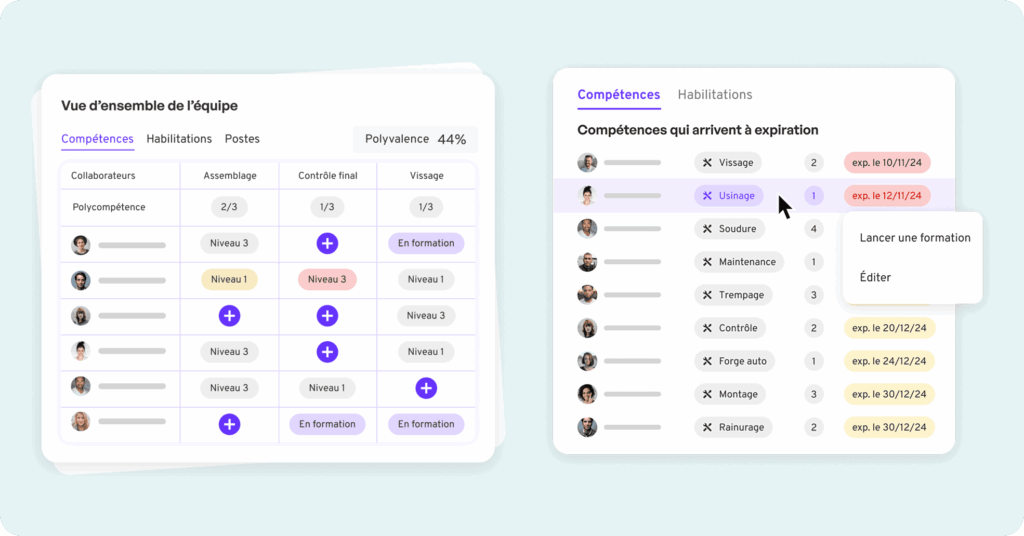
🎯 Request a free demo of Mercateam software
Import your team and skills in just a few minutes, define your scale, and obtain a multi-user matrix updated in real time - with alerts on authorizations to be renewed and a complete history of changes. Used by over 300 industrial sites (Dior, Bonduelle, aeronautics, automotive, pharmaceuticals).
Create my free matrixWhy use a skills matrix?
A skills matrix makes it clear who can do what, at what level of proficiency, and with what valid authorizations. This information usually remains in the manager’s head and leaves with him as soon as he changes jobs.
Formalizing this process makes it possible to identify the skills possessed by each individual, tailor training to address actual skill gaps, prepare the next generation of leaders, and ensure objectivity in annual performance reviews.
Ensuring the safety of workstations staffed by a single person
Comparing the skills required for each position with the observed skill levels reveals which positions lack a trained replacement. A column with only one checked box indicates that work is likely to come to a halt as soon as that person is absent.
The risk becomes a regulatory issue when the position requires a certificate with an expiration date: CACES R.489, NF C18-510, ATEX. The matrix shows the expiration date for each certification and issues a reminder before it expires, allowing time to schedule refresher training and train a second certified individual.
Structuring training plans
The difference between the required level and the observed level is read cell by cell, and it is this difference that makes up the training plan. A «novice» operator in a skill area expected at the «independent» level becomes a need that is identified, quantified, and subject to committee review.
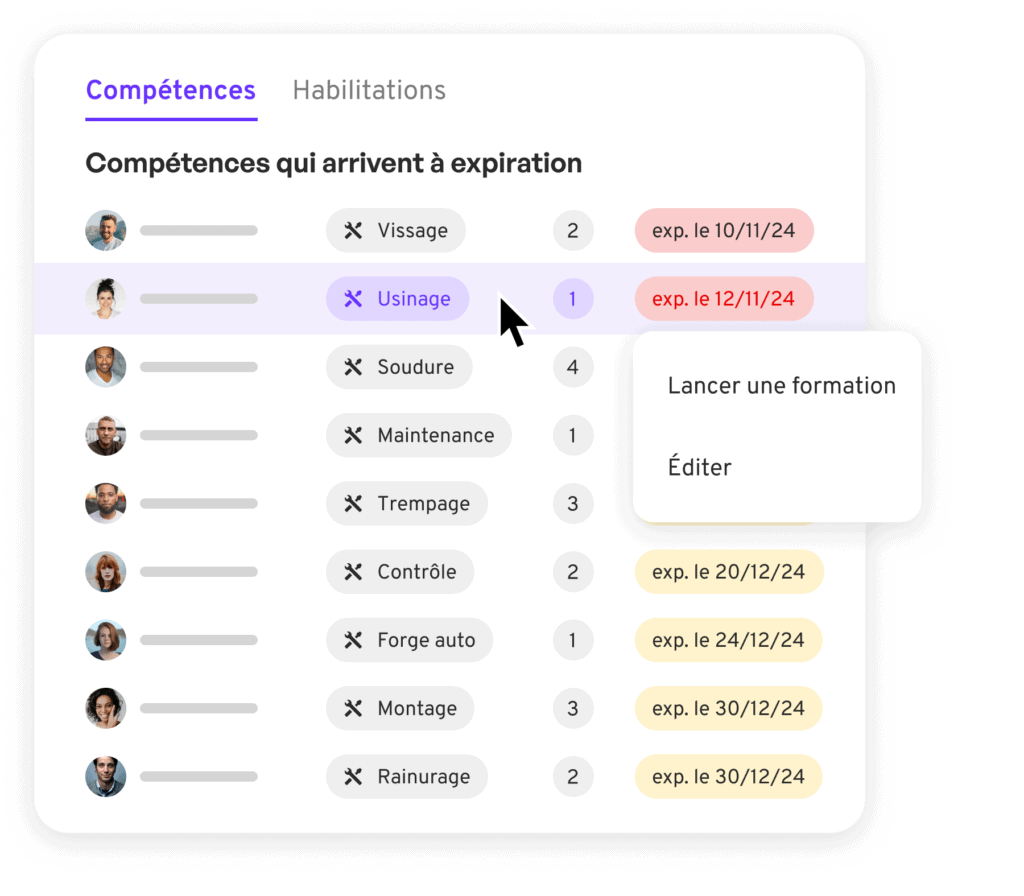
Example of a training plan based on the competency matrix
The budget, then, funds identified shortfalls, rather than a catalog of modules purchased in bulk. This is also what the skills development plan, the official name of the training plan since 2019: priorities that can be justified to employee representatives.
Preparing the next generation and securing versatility
A skills matrix shows where the expertise held by too few people is concentrated and how soon it is likely to disappear. An operator who retires after thirty years on the same production line takes with them practical skills that aren’t covered in standard procedures. If identified early enough, these skills can be passed on through mentoring while the operator is still on the job.
The same matrix is used on a daily basis: before creating a schedule or covering for an absent employee, the manager can see who is available to fill the position and at what level. Finally, it provides the evidence of competence required by the ISO 9001 standard (§7.2) and serves as operational support for a GPEC process, renamed GEPP since 2017.
Objectivize annual performance reviews and compensation
A competency matrix provides a verifiable basis for the annual review: a move from a 2 to a 3 in production line management and from a 1 to a 2 in format change, relative to the goals set the previous year. The employee can see what skills they still need to acquire to advance, and the manager bases their evaluation on specific, dated facts.
Some companies base a versatility bonus on the number of positions an employee is qualified to fill, which requires a regularly updated chart and a grading scale that everyone understands.
The 4 Types of Competency Matrices
Depending on whether you're preparing an annual appraisal, managing a team rotation or launching a project, the format will change.
Individual Competency Matrix
The individual matrix It compares an individual employee’s current skills with the level expected for their position and serves as the basis for annual and performance reviews. A team leader who brings on a temporary employee for three weeks can use it to identify, in just ten minutes, the priority skills that need to be transferred, rather than discovering midway through the assignment that the employee lacks the necessary qualifications for the assigned position.
Team Competency Matrix
The team matrix (or departmental) matrix displays all employees in a given area on a single chart. A color code reveals strengths and weaknesses at a glance: a department where three out of ten skills are held by a single person is vulnerable, and the matrix makes this vulnerability immediately clear. By cross-referencing availabilities and levels, managers can anticipate assignments instead of having to deal with absences on Monday mornings.
Project Competency Matrix
The project matrix is set up for a specific case: line launch, equipment deployment, production transfer, site opening. It highlights the need for training or temporary recruitment at the planning stage, before a skills shortage becomes a bottleneck.
The versatility matrix (or multi-skilling) becomes critical in continuous flow: the absence of a single person can bring an entire chain to a standstill. Ratings from 1 (can observe) to 4 (can train others) pilot rotation and cross-training.
Career Development Competency Matrix
The evolution matrix compares the current level with a target level to be achieved within 6 to 12 months and transforms the diagnostic matrix into a management tool. Some organizations supplement it with a radar chart (Kiviat) to visualize the profiles in the skills assessment.
Is the skills matrix compulsory?
L'article L.6321-1 of the Labor Code requires employers to ensure that employees are adapted to their workstations, and that their ability to hold a job is maintained in the light of changes in jobs, technologies and organizations. The matrix is not compulsory as such, but it is the practical tool that materializes this obligation: it documents the gaps and the training actions undertaken to fill them.
Beyond 300 employees, l'article L.2242-20 requires three-yearly negotiations on the management of jobs and career paths. The matrix naturally feeds into these negotiations by providing a map of available skills, gaps and training paths.
Visit RGPD, All personal data is stored for the duration of employment. Retention is limited to the duration of employment, plus legal traceability obligations, access is restricted to the direct manager and HR, and the purpose (management, training, audit) must be documented in the processing register. A non-secure matrix exposes the company to the risk of being reported. CNIL in the event of leakage or misuse.
How to build a skills matrix in 5 steps?
Once you've chosen your format, the construction process always follows the same sequence, whatever the size of your service.
Step 1. Identify key skills for the position or department
Start with your reference framework, if one exists; otherwise, use job descriptions and standard operating procedures.
- First, list the technical skills essential (machine operation, quality control, first-level maintenance, traceability, HACCP standards).
- Then add the soft skills that influence collective performance: the ability to form a new team, managing priorities in adverse conditions, and communicating with maintenance.
The classic mistake is to aim for completeness: a matrix with 30 skills becomes unreadable, and no one updates it.
Go to 8 to 15 skills per department, by retaining only those that condition an assignment or a measurable level of performance.
Step 2. Define mastery levels
Without clear descriptors, assessment becomes subjective and inconsistent from one manager to the next. In most cases, four levels are sufficient:
- Level 1 (novice) knows the principles but works with a tutor.
- Level 2 (operational) remains autonomous under normal conditions, and requires assistance in unusual situations.
- Level 3 (confirmed) masters hazards and adapts practices to changing conditions.
- Level 4 (expert or trainer) transmits skills, diagnoses complex malfunctions and suggests improvements.
Each level must be associated with observable behaviors. «Knows how to operate the machine» is too vague. «Performs a format change alone in less than 15 minutes, with zero non-conformities over the last 10 operations» is a criterion on which two managers agree.
Step 3. Assess current skills
The assessment is based on three cross-referenced sources :
- employee self-assessment
- Evaluation of the Direct Manager Through On-the-Job Observation
- peer feedback or 360-degree evaluation.
Self-assessment promotes buy-in but must be grounded in reality.
An employee who rates himself a 2 while his manager rates him a 3 needs reassurance, not training.
Conversely, someone who rates themselves a 4 in a skill area where their manager rates them a 2 needs some guidance, not a promotion.
Step 4. Fill in and analyze the matrix
Once the evaluations have been collected, a color code enhances legibility:
- Green indicates satisfactory levels (3-4).
- Orange marks intermediaries requiring a skills upgrading plan (2).
- Red identifies absent or insufficient skills (0-1).
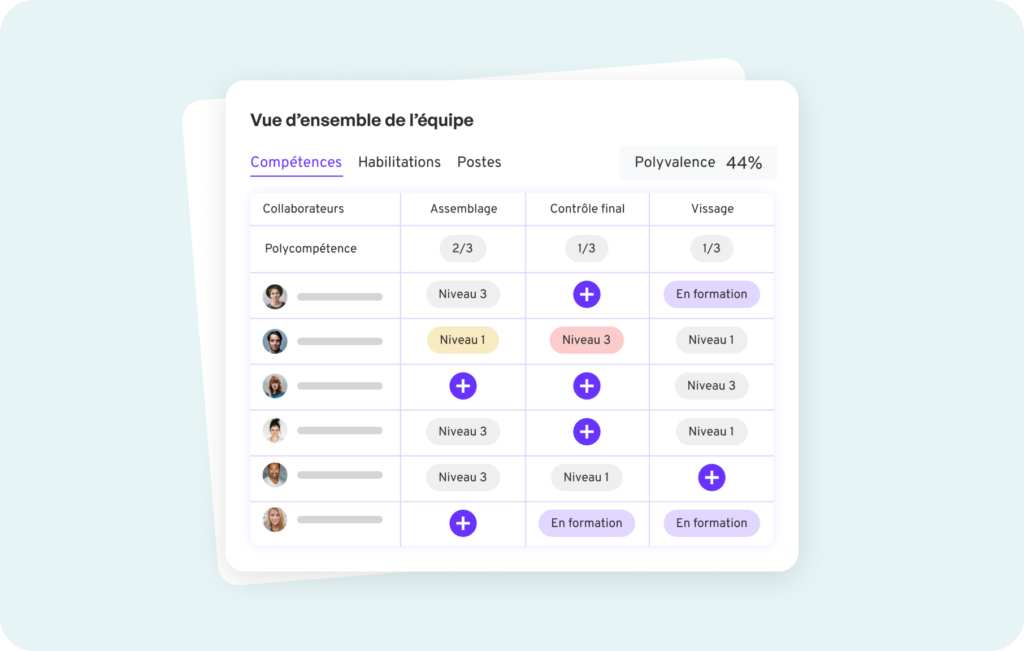
Example of a competency matrix
The column reading reveals fragile skills. Visit online reading distinguishes between versatile profiles and those confined to a narrow spectrum. The right operational questions then arise: which skills should be strengthened first, which mentoring pairs should be set up, is it necessary to recruit, or is internal skills development enough?
Step 5. Use the results to take action
A matrix that entails no action remains an administrative exercise. Exploitation takes four forms: targeted training on red skills, mentoring between experts (level 4) and development employees, pair reorganization to ensure redundancy of critical skills, mobility path for profiles close to a neighboring position.
Example of a skills matrix (for a packaging line)
Let's take a completed team matrix on a packaging line, with six critical skills and a scale from 0 (not held) to 4 (expert or trainer).
| Operator | Line control | Format change | Quality control | Maintenance N1 | HACCP traceability | New training |
|---|---|---|---|---|---|---|
| Sophie M. | 4 | 3 | 3 | 2 | 4 | 4 |
| Karim B. | 3 | 3 | 2 | 3 | 3 | 2 |
| Nathalie R. | 2 | 1 | 3 | 1 | 2 | 1 |
| Youssef D. | 3 | 2 | 2 | 4 | 2 | 2 |
| Interim | 1 | 0 | 1 | 0 | 1 | 0 |
Four interpretations immediately stand out from this table.
- Sophie is the only one capable of training new employees on production line operations and HACCP traceability, which makes this a vulnerability whenever she is absent.
- The change in format results in an overall shortfall: if Sophie and Karim are both absent on the same day, no one can complete it on their own.
- Youssef has potential in maintenance—he is the only expert in the group—but he is behind in traceability, which is holding him back from advancing to team leader.
- The last row of the table shows low scores across the board, which is consistent with a short assignment but strongly influences the assignment location.
The actions are straightforward: have Nathalie work with Karim in a one-on-one training session over three months to transition to the new format; transfer responsibility for training new hires from Sophie to Karim to reduce dependence; and enroll Youssef in an HACCP training course to open up career opportunities for him.
For operators on short-term assignments, the onboarding program focuses on production line operations and HACCP traceability—the two areas where the team is most at risk.
Decisions:
- Nathalie paired up with Karim on the format changeover from April 15, with the aim of achieving level 2 by July 15.
- Karim will take over from Sophie as trainer for the integration of new employees from May 1.
- Youssef registered for the HACCP session in June, aiming for level 3 by the end of the year.
The exercise takes less than thirty minutes once the matrix has been completed. The decisions that emerge are budgetable (cost of training), plannable (schedule of pairings) and measurable (evolution of levels over three months). This is the difference between «we should train Nathalie» and «Nathalie is paired with Karim on the change of format from April 15, aiming for level 2 by July 15».
5 Mistakes to Avoid When Using a Competency Matrix
When a matrix falls into disuse, the format is rarely to blame. Rather, the problem lies in how it is built, maintained, and utilized. Here are the five most common mistakes made in production departments.
Mistake 1. Filling out the matrix from the office
When HR fills out the matrix based on job descriptions and training history, it describes what employees should their skills, not what they actually do. On the job, the discrepancy is glaringly obvious. One operator is rated a 3 on a format change he hasn’t performed in two years. Another is rated a 1 even though he handles troubleshooting for the entire night shift.
Ratings must come from the team leader who observes the position and must be compared with the employee’s self-evaluation. HR ensures the method and scale are followed, but does not determine the ratings.
Mistake 2. Forgetting the required qualifications for the position
If the matrix shows only the observed levels, it remains merely an inventory. The expected level must be set for each position: for example, 3 for line operation for a driver, and 2 for a general-purpose operator. Without this, it is impossible to tell whether a 2 is a problem or whether it is normal.
Add a «required level» row at the top of each column. This row transforms the matrix into a list of gaps and then into a costed training plan.
Mistake 3. Updating the matrix once a year, before the audit
A matrix updated the day before the ISO audit is accurate for only one day a year. The rest of the year, the manager who creates the schedule relies on outdated figures. A temporary employee who was trained three weeks ago isn’t listed, while a permanent employee who has been transferred is still listed.
Updates should be based on actual events, not the calendar: completed training, arrival, departure, job change, new product, or new equipment. Every training session that isn’t reported makes the matrix a little less accurate.
Case Study: LISI Aerospace—Training Audits Prepared in Just a Few Clicks
At LISI Aerospace, training data was scattered across Excel files and paper documents in the field. Every training audit required HR to spend hours gathering everything together. Training needs were not effectively communicated from the field to HR.
The group has integrated its continuing education program into its competency matrix with the Mercateam training module. The results:
- Audits prepared in just a few clicks. All data is centralized. HR anticipates the necessary resources, identifies gaps, and develops a digital training plan.
- Training programs launched more quickly. Field staff and HR work with the same information, without having to re-enter data or follow up manually.
- Real-time tracking. Skills development is tracked on a team-by-team basis. The integration of internal and external training programs enables us to confidently meet the requirements of external audits.
- Training time reduced by a factor of 4. A customized workflow addresses the needs of each employee and accelerates skill development.

Mistake 4. Leaving temporary workers out of the matrix
Many systems track only permanent employees. Yet, during peak periods, temporary workers fill a significant portion of the positions. And it is often in their case that we discover—too late—a lack of authorization or proficiency.
Even if their skill levels are low, they should be integrated. Their integration process can then be tailored to focus on the skills where the team is most vulnerable. We also verify their clearances before assignment, not after.
Mistake 5. Not following any indicators
Without metrics, no one knows whether the matrix is improving the situation. There’s no need to create a complex dashboard: four numbers are enough, reviewed each month during the team meeting.
- Exclusive Jurisdiction : the number of critical skills held by a single person at Level 3 or higher.
- Coverage Rate by Position : Number of people meeting the required level, relative to the number of people needed per team.
- Average Deviation between the required level and the observed level, skill by skill.
- Expiring Authorizations within the next 60 days.
If the number of skills with only one holder does not decrease from one quarter to the next, it is because the training programs are not focusing on the right skills.
Bringing the matrix to life
A competency matrix is only as valuable as its regular updates and the actions it triggers. Developed in collaboration with front-line managers, updated with each completed training course, and integrated with team reviews and audits, it becomes the document that guides a department’s day-to-day operations. Left unattended, it reverts to an archived file consulted only once a year before the audit. To get started quickly, download the pre-configured Excel template. If you manage multiple sites or have a growing number of certifications, a Mercateam demo will show you a multi-user matrix updated in real time, with automatic alerts for certification renewals.
Download our free Excel skills matrix template
To get started without investing in a dedicated tool, our Excel skills matrix template free of charge is calibrated for the industry: predefined level scale, conditional color formatting (green / orange / red), «expected level» line to visualize deviations, and versatility tab connected to the main matrix to track flexibility by position. You adapt it to your department in less than an hour, then follow the steps in this guide to complete it without falling into the classic pitfalls.
Industry-calibrated: predefined level scale, conditional color formatting (green / orange / red), «expected level» line and connected versatility tab. Adaptable to your department in less than an hour.
Download the free Excel template