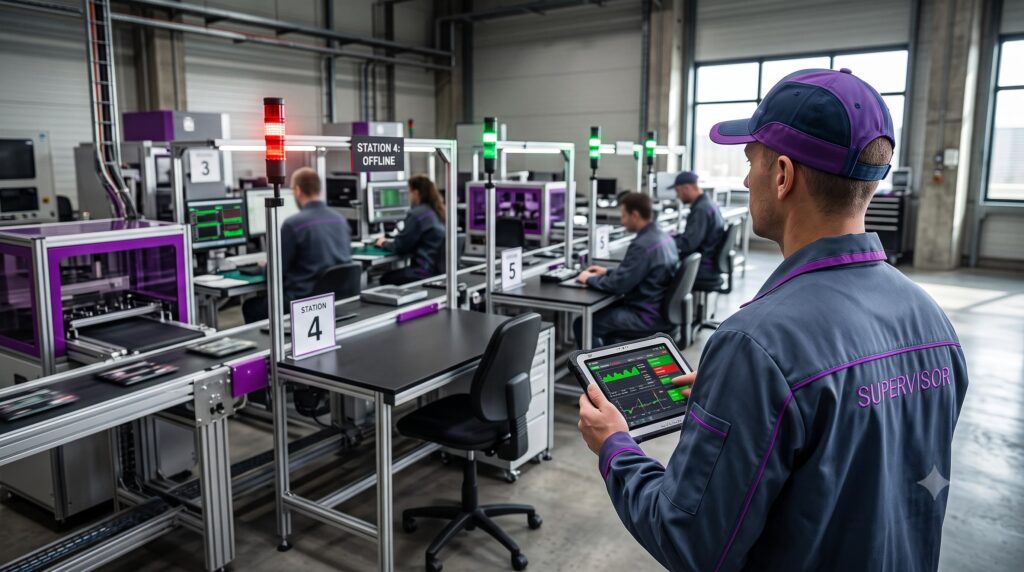

A quality audit is coming up. You open the workshop’s skills tracking file, and three tabs show conflicting information: two authorizations with no expiration date, and a certification that no one knows if it’s still valid. Yet the spreadsheet is doing its job. What it lacks is consistency, since this data is only updated once or twice a year—during performance reviews or right before an audit. In the meantime, training courses are completed, authorizations expire, assignments change, and the gap with the reality on the ground widens. A skills monitoring It only delivers on its promise when used continuously, as a management tool rather than a snapshot taken once a year.
What is company skills monitoring?
Visit on-the-job skills monitoring, ...it involves the ongoing process of collecting, updating, and analyzing the expertise possessed by your employees.
An annual assessment provides a snapshot of a situation at a specific point in time; monitoring, on the other hand, is a long-term process that tracks changes over the course of months and identifies deviations as they arise, when they can still be corrected.
This consistency makes it useful in everyday life, and not just in job interview.
One issue we see recurring on almost every website: the matrix confuses «has completed the training» with «holds the position.».
You’ve likely already encountered this situation in your data: a staff member marked as “trained” even though they still need to pass a practical evaluation for the position. As long as this distinction isn’t tracked, your performance metrics will overestimate your actual competencies—and this is precisely the kind of discrepancy that continuous monitoring brings to light.
A structured follow-up process covers four areas:
Four Dimensions Do not mix
An industrial SME with 50 employees stands to gain just as much as a large corporation by formalizing this monitoring process: ensuring that assignments are secure, preparing for audits without having to scramble to find replacements at the last minute, and avoiding reliance on a single operator for a critical position.
The regulatory framework for the PPIM, which replaced the GPEC in 2017, requires companies with more than 300 employees to engage in triennial negotiations; however, it is primarily these on-the-ground challenges that justify a long-term approach.
How Continuous Monitoring Changes Production
In an office, a skills gap can delay a project. On the production floor, it can shut down a line, cause an audit to fail, or lead to an accident, which requires continuous monitoring, updated in real time as the line operates.
The following four benefits all stem from the same shift—the one that takes you from an annual snapshot to dynamic data.
Anticipate deviations before they become critical
Continuous monitoring flags a skills gap months in advance, because it highlights the skills possessed by a single individual—the ones that are most expensive to replace.
The issue goes beyond this isolated case, as French industry is facing a wave of retirements between now and 2030, and Every unexpected departure brings with it practical experience which no job description can fully capture.
Reliable planning and assignments
Monday, 6 a.m.: There’s a staff shortage on Line 3. If the team leader has to rack their brain or make three phone calls to find a qualified replacement, the half-hour lost will delay the entire start of the shift. With an up-to-date roster, the team leader can see in a matter of seconds who is authorized to work that position and available during that shift.
At a site with 80 to 150 operators spread across multiple lines, the timeliness of the data directly determines the quality of staffing assignments. Up-to-date data enables quick replacements and reliable schedules; outdated data leads to guesswork and poorly covered shifts.
Stress-free preparation for quality audits
During a ISO 9001 audit, whether it’s IATF 16949 or NADCAP, the auditor requires proof that the operator assigned to a position does indeed possess the required skills and authorizations. When this evidence relies on an Excel spreadsheet with tabs dating back six months, it quickly becomes a nonconformity.
Continuous tracking provides the expected traceability: who is authorized, starting when, and through when—all accessible with just a few clicks. At the sites we equip, companies that have digitized their tracking go through their audits with less stress and above all fewer hours spent urgently reconstructing supporting documents.
Improve the versatility of your teams
The versatility rate indicates how well your teams can cover multiple positions. In production, it determines your ability to handle an absence, a surge in workload, or staff turnover; the higher it is, the less an isolated incident disrupts the production line.
This versatility is built over time, and managing it requires first measuring it. Tracking skills supports this assessment by showing, position by position, the number of qualified operators. For the formulas and methodology, we explain how measure the rate of polyvalence of your teams in a dedicated guide.
The 5 key indicators for monitoring skills
Without metrics, monitoring remains purely declarative. For data to guide decisions, it must be translated into measurable KPIs. Here are the five you should prioritize—the ones that come up most often on the websites we work with:
- Visit coverage ratio from critical skills indicates the percentage of critical positions held by at least two qualified operators; under 100 %, even the slightest absence jeopardizes production.
- Visit versatility rate per line or per workshop, this ratio represents the average number of workstations managed by each operator divided by the total number of workstations; the higher the ratio, the better the organization can handle unforeseen events.
- Visit authorization log with expiration dates of 30, 60, and 90 days, and reviewed weekly, this prevents you from discovering an expired security on the day of the audit.
- Visit training plan completion rate measures the percentage of scheduled training sessions that are actually held; when it drops, production demands have taken precedence over skills development.
- L'gap between required skills and actual skills, gap analysis quantifies the gap between current and expected levels for each position and is used to prioritize training opportunities rather than simply piling them on.
These indicators make sense over the long term, not in an annual report. What matters is the trend: Is the versatility rate increasing from quarter to quarter? Are the gaps closing? Are certifications being renewed before they expire rather than after? In our experience, a company capable of answering these three questions already has a monitoring system in place that works.
How often should I update my skills tracker?
There is no single frequency that applies to all situations, because the right pace depends on the type of skill and the associated risk. Four different frequencies work together to meet the needs of a workshop like yours, ranging from ad-hoc updates to strategic reviews.
Four rhythms that combine
Click on a level to see the corresponding skill type and the associated action.
Authorizations and certifications, in real time
Regulatory certifications (CACES, electrical certifications, quality certifications) have a fixed expiration date. Once that date has passed—often without anyone realizing it—the operator can no longer be assigned to the position, and the next audit will flag the noncompliance.
The most effective approach remains the automatic alert sent 90, 60, and then 30 days before the due date. At ISO- or NADCAP-certified sites, this real-time monitoring is part of the operational requirements that must be demonstrated. Skills management software triggers these alerts automatically, whereas in Excel you have to set them up manually—and this is typically the step that gets skipped when production is under pressure. In fact, this is the whole point of a authorization management digitized.
Operational Skills, Throughout the Month
Operational skills change faster than we realize: a training program is completed, a temporary worker joins the team, or an operator switches production lines. Ideally, the team leader or production manager should update the matrix after each event; if that’s not possible, a monthly review can catch up on anything that slipped through the cracks.
The common pitfall is waiting until the annual review to address everything. For eleven out of twelve months, assignments are based on data that no longer reflects the reality on the shop floor. In my experience, it’s this monthly cycle that goes off the rails first—long before the certifications that everyone keeps an eye on—because it doesn’t trigger any regulatory alerts: no one reminds you that a job qualification has just changed. If you had to prioritize making just one cycle more reliable to start with, it would be this one.
The Quarterly Review and the Gap Analysis
The quarter is the ideal time to take a step back. The manager lays out the key metrics and assesses the big picture: which critical skills depend on just one person, which gaps have widened over the past three months, and what progress has been made toward skill-building goals.
This is the time to adjust the training plan when certain activities have fallen behind schedule, and to update the skills mapping by identifying areas of vulnerability at the workshop or site level.
Annual Strategic Alignment
Once a year, skills data informs key decisions: multi-year training plans, workforce planning, GEPP negotiations, and succession planning. At this level, we cross-reference available skills with the industrial roadmap to anticipate which jobs are evolving and which skills will be in short supply in twelve or eighteen months.
The performance review, which is mandatory every two years, is part of this approach but does not fully capture it. A solid annual assessment is based on data accumulated month by month, never on a retrospective analysis at the end of the fiscal year.
Building an effective skills monitoring dashboard
Excel or specialized software to track skills?
| Criteria | Excel | Dedicated software |
|---|---|---|
| Cost | Free, already available Excel Advantage | Subscription |
| Expiration Alerts | Hand-sautéed under pressure Weak point | Automatic 90/60/30 days Native |
| Consolidated view | Merge Multiple Workbooks Manual | Filterable by workshop / line Real time |
| Audit Traceability | Reorganized on short notice At risk | Native, searchable Ready |
| HRIS / ERP connection | Double entry Absent | SAP, Oracle, ADP Integrated |
| Maintenance time | Increases with size Heavy | Real-time updates Lightweight |
Excel defends itself against a team of about 15 people with consistent skills. These limitations become apparent as the organization grows and the level of traceability required during audits increases.
A good dashboard provides the right information to the right person, at the right level of detail. Since a site manager and a team leader don’t make the same decisions, it offers several levels of detail:
- The Director of Operations monitors a consolidated overview: overall versatility rate, critical skills at risk at the site, and progress on the training plan.
- The production manager works on a workshop-by-workshop basis: who is qualified for which position, which authorizations expire this month, and which gaps need to be filled first.
- The team leader remains at the operational level: for each shift, he ensures that qualified operators are available for each workstation.
Consolidated into a single tool and updated every time the matrix is modified, these views are ready for both the quarterly review and the audit, without the need for recompilation.
This automation of reporting frees up to half a day per week for managers—time that can be redirected to the shop floor rather than spent consolidating spreadsheets. This fulfills the promise made at the outset: skills tracking that moves in step with production and is ready well before an audit is even announced—a far cry from the days when everything started with a file that had to be hurriedly reopened at the last minute.
View the competency matrix Mercateam in Action
A tracking system that reduces the team leader’s workload instead of adding another form: real-time updates, automatic alerts, and audit-ready reports. With our solution, automation cuts user training time by 75%.
Book a demo