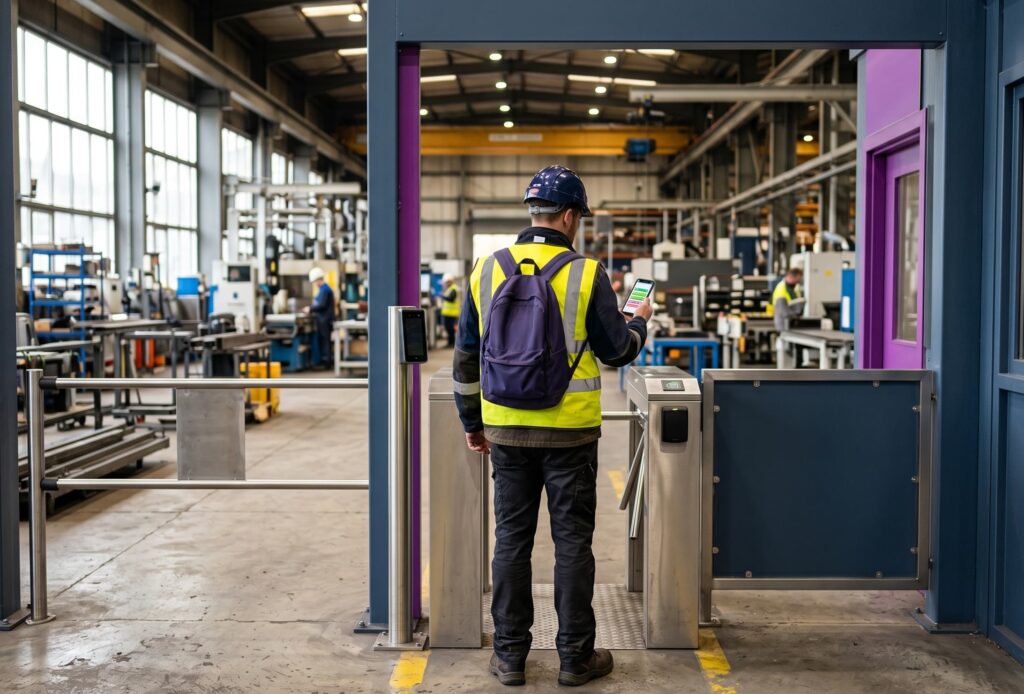

Every week, temporary workers, subcontractors, service providers and visitors arrive at your industrial site. For each of them, the same half-hour safety welcome has to be repeated face-to-face, for someone who may be leaving in three days' time. Pre-onboarding reverses this logic: the security reception of your external stakeholders takes place remotely, before they enter the portal. Mercateam introduces this feature so that your outsourcers arrive already trained, certificate in hand, ready to work from the first minute.
Discover Mercateam's pre-ondoarding video

Safety reception for externals, a face-to-face event repeated dozens of times a week in the factory
Every week, a production site receives dozens of visitors from outside its workforce. Each of them goes through the same safety reception, often led by a manager who leaves his or her desk to explain the instructions, the traffic plan and the mandatory PPE. Multiply this by the number of arrivals: the half-hour unit becomes several hours per week, taken from the time of your HR, QHSE and production teams.
When arrivals follow on from one another, the temptation to cut to the chase lurks, and the welcome is shortened, instructions are given orally without a trace, and clearance checks are postponed until the following day. The content ends up varying according to who's doing the greeting, and so does the quality. And on the day of an audit, reconstructing proof that each external employee has been properly trained is a headache when everything is based on paper sign-in sheets.
On the sites we support, this is one of the first areas of friction that QHSE managers describe to us, and it culminates at the most tense moments: seasonal peaks in the food industry, when waves of temporary workers arrive in a matter of days, or the preparation of a NADCAP audit in the aeronautics industry, where a missing piece of evidence is paid for dearly.
What the French Labor Code requires for the safe reception of external workers in industrial environments
This requirement for proof stems directly from the French Labor Code. Articles L.4141-1 and L.4141-2 require safety training for all new arrivals, and the principle of equal treatment applies to temporary workers and permanent employees alike. In the case of a temporary assignment, it is the user company, i.e. you, that remains responsible for the conditions of performance and safety throughout the duration of the assignment (article L.1251-21).
This obligation applies to everyone:
- temporary workers sent by a temporary employment agency,
- subcontractors for maintenance or industrial cleaning,
- technical service providers who intervene on an ad hoc basis,
- visitors, auditors and suppliers.
Beyond the legal framework, it's people's real safety that's at stake here. In 2024, Health Insurance recorded 549,614 accidents at work, or 26.4 per 1,000 employees, and temporary workers have a frequency index well above the average, because they combine exposed positions, rapid induction and co-activity with your teams. This is where traceability becomes decisive, because in the event of an inspection you need to prove that the reception took place and that it was understood, not just asserted.
This reception is coordinated with the prevention plan, which governs the risks of interference between your activity and that of external companies, and with the authorization management (electrical, CACES, fire permit) expected on site.
What pre-onboarding is and what it means for factory safety reception
Pre-onboarding is the key to meeting this obligation, without overwhelming your teams. Pre-onboarding consists of providing remote training before the worker arrives, rather than concentrating everything on site on D-day. The person receives their safety induction course on their phone, follows it whenever they want, and shows up already trained.
There's no account to create, no application to install, no need for a professional e-mail address: an external user can access the content directly, which removes the barrier we see to most people dropping out, because a temp summoned for five days doesn't create an account or download an application to follow a training course.
One point needs to be made clear: pre-onboarding covers general safety induction, i.e. site rules, instructions and conduct. It does not replace consideration of the risks specific to the workstation and the co-activity, which is verified in the field on the day of the intervention. What it does is take the repeatable part out of reception, and reserve face-to-face time for what really needs to be done on site.
Create and share a safety journey in just a few minutes
From the manager's point of view, everything is controlled from the dedicated pre-onboarding platform: it takes just a few minutes to create a complete itinerary, which can then be shared via the channel of your choice.
A journey through text, images, videos and validation quizzes
An HR, QHSE or production manager assembles the course from his or her own materials: text for instructions, images for the traffic plan, videos for high-risk gestures, and a quiz to check that the content has been understood, not just scrolled through. You retain control over this content and adjust it according to the site or type of intervention, without having to start from scratch each time.
Share by SMS, link or QR code
There are three ways to transmit the quiz: an SMS sent to the person's phone, a link sent by email, or a QR code displayed on the site's home page. The participant scans or clicks, follows the content, validates his or her quiz, and immediately receives his or her certificate of achievement on his or her phone. When they arrive at the portal, their general training has already been validated and tracked, and the on-site reception staff concentrate on their job.
A safety welcome tour created and shared in minutes
Text, images, videos, quizzes, then send by SMS, link or QR code. See how your externs arrive already trained, certificate in hand.
Book a demoAutomatic translation of content into over 50 languages
On an industrial site, your service providers don't all speak the same language, and a half-understood security welcome doesn't protect anyone. Mercateam automatically translates your content into over 50 languages, and not just text: audio and video too. Whether a temporary worker, a service provider or an employee of another nationality, each operator follows your site's welcome path, in his or her own language, and validates the same quiz. Your welcome remains consistent whatever the language spoken at the site entrance, without you having to produce and maintain a version for each language.
The subcontractor portal for delegating registration to temporary employment agencies
Temporary employment agencies are less and less present on site. You retain control over the content of the security reception desk, without having to manage registration on a person-by-person basis. The administrative burden shifts back to the staffing agency, and on your side, the interim management is limited to checking that everyone has validated their route before arriving.
Real-time monitoring of safety checks carried out prior to site entry
A dashboard shows you, in real time, who has taken the course, how long it took, who has validated the quiz and who is therefore ready to go on site. Scattered attendance sheets and paper binders disappear in favor of a dated, usable history. On the day of an audit, the proof is already in place: each validated course is time-stamped, the quiz score is recorded, and the certificate is archived. This follow-up extends the logic of a training follow-up centralized, where every security reception carried out feeds directly into the site's compliance file. And since this file contains personal data of stakeholders, it remains hosted in Europe, on an ISO 27001 and SOC2 Type 2 certified platform, compliant with the RGPD.
What pre-onboarding means for your teams and your audits
By moving the security reception to the pre-arrival stage, pre-onboarding acts on four points for your site:
- your HR, QHSE and production teams get back the hours they spend redoing the same reception; ;
- the quality of the welcome becomes homogeneous, whatever the person receiving it; ;
- your compliance is tracked and ready for audit, including in multiple languages; ;
- your external contributors arrive operational from the very first minute.
Since 2019, we've been equipping over 300 industrial sites, and one observation is repeated everywhere: what happens in the first few minutes of an extern on site engages his or her safety for the entire duration of the mission. Putting people back at the heart of Industry 4.0 starts here, by bringing in every person who has already been trained. Pre-onboarding adds to our QHSE software to cover the reception of externals, from the first SMS to the certificate.
To see it working on a site comparable to yours, request a demo.
Get your externals up and running from the very first minute
More than 300 industrial sites equipped since 2019. See how pre-onboarding works on a site comparable to yours, from the first SMS to the certificate.
Book a demo