

In a factory, you don't replace a position; you replace skills.
When an operator leaves, what really disappears is a set of skills—sometimes the only ones at the site capable of handling a critical line.
Visit skills-based management Based on this observation: we manage the organization based on what the teams are capable of doing.
Assignments, training, schedules, and last-minute absences are then decided based on this, rather than on job titles.
This is an approach the industry has been using since the advent of lean, though it hasn't always been called that.
What is competency-based management?
Competency-based management is an organizational management approach that places individual and collective competencies at the center of decision-making: operator assignments, training plans, forecasting needs, and managing contingencies. Whereas a traditional organization thinks in terms of job descriptions («I need an operator for position 12»), this approach thinks in terms of capabilities («Who on my team has the skills required for position 12, and at what level?»).
From a fixed position to the operator
Click on the map on the right to Explain the specific example of each line.
The difference with administrative skills management
Competency-based management is often confused with competency management, even though the two have different purposes. Competency management (GPEC, renamed GEPP in 2017) is first and foremost an inventory exercise: skills are mapped, reference frameworks are updated, and forms are filled out during annual reviews. The tool exists, but it often ends up in a drawer—sometimes literally.
Competency-based management makes this mapping a tool for day-to-day decision-making. The skills matrix It is no longer just an HR document filed away after the audit; instead, it has become the screen that the team leader checks every morning to assign operators based on available skills, valid authorizations, and the day’s production needs. The difference lies less in the tool itself than in how it’s used, and its primary user is the front-line manager—not the HR department. Ask yourself this: Was your most recent competency matrix opened by a team leader to assign their team, or by an auditor to check a box? The answer reveals where you stand.
Why is the industry switching to this model?
The constraints driving this transition are operational in nature—familiar to any production manager—and they are becoming more severe with each passing year. Two of them are more significant than the others.
Job-based management no longer holds up in the face of absenteeism and turnover
When an organization relies on rigid job descriptions, every unplanned absence triggers a chain reaction: the team leader looks for a replacement, realizes that no one else is trained for the role, and then either slows down the production pace or urgently reassigns staff at the expense of another production line. In France, the absenteeism rate in manufacturing and construction has reached 4.59 % in 2024, up from 15 to 19 % year-over-year, with an average downtime of 24.1 days, and it had already surpassed 5.9 % in the first half of 2025.
The rate had already risen to 5.9 % in the first half of 2025. Every uncovered absence triggers a chain reaction when the organization relies on fixed positions.
Sites that have developed multi-skilling Their operators are able to handle these unforeseen events without interrupting production. An operator trained in three positions instead of just one triples the team’s adaptability. Competency-based management provides a framework for this versatility: rather than leaving it to the whims of individual initiatives, it organizes, measures, and develops it.
Lean laid the foundations without saying so
Competency-based management is not an HR concept imported into the factory; it originated there. The TWI (Training Within Industry) program, developed in the 1940s and integrated by Toyota into the Toyota Production System, was already based on a simple principle: training each operator to work in multiple positions, structuring skill development, and entrusting supervisors with the responsibility of developing their teams. The skill matrix, a tool native to Lean, was used precisely to visualize who knows how to do what and to identify gaps in the workforce.
Jeffrey Liker, in formalizing the principles of the Toyota Way, added an eighth form of waste to the seven defined by Taiichi Ohno: the underutilization of employees’ skills and creativity. He considered this to be the worst, because it indirectly fuels all the others. Moving from a lean skills matrix From the poster on the workshop wall to dynamic skills management, this approach extends that philosophy using today’s resources.
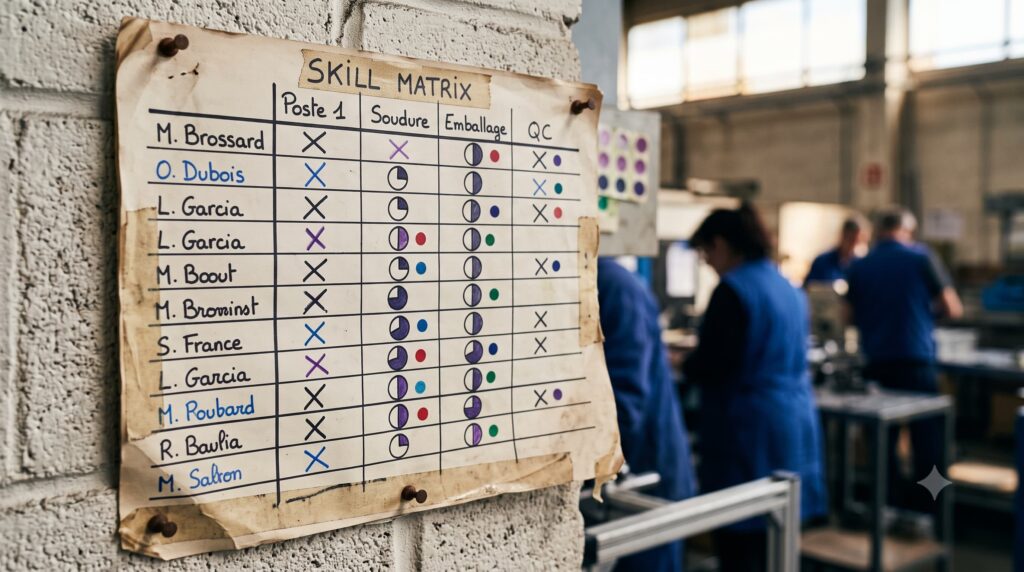
How can we move from job-based management to skills-based management?
The transition doesn't happen overnight, but it doesn't require starting from scratch. In practice, sites that successfully make this transition follow four steps, starting with their most critical areas
From the job to the skills, in 4 steps
Click on a step to see its objective. Always start with your most critical scope.
To make visible what team leaders already know informally: who can actually do what, at what level, and with what valid authorizations. Objective: a common language on what it means to «master a position.» Four levels are sufficient (in training, supervised, independent, capable of training others).
Map the team's actual skills
The first step brings to light what team leaders already know informally: who can actually do what, at what level, and with what valid authorizations. This work is done with them, not in an HR office, because they are the ones who can distinguish between an operator who is «trained on paper» and one who can truly perform the job independently. A practical tip on the proficiency scale: four levels are more than enough (in training, supervised, independent, capable of training others); beyond that, team leaders stop filling it out. Our guide on the deployment of a plant skills matrix outlines the complete method; the goal here is to establish a common language between the manager, their team, and HR regarding what «mastering a position» actually means.
Identify critical skills and weaknesses
Once created, the matrix quickly reveals areas of risk. The most common ones at an industrial site are:
- A single operator trained on a critical workstation—the single point of failure that brings an entire line to a standstill as soon as that operator is absent or leaves the company.
- Skills possessed only by employees nearing retirement, with no succession plan in place.
- A gap between the competencies required by quality audits (NADCAP, ISO 9001) and those actually covered by the team.
In my experience, at any given site, two or three positions account for the bulk of the risk, and it’s best to start with those rather than trying to cover the entire matrix right away. This assessment of vulnerabilities directs the training budget toward the skills that are critical to production continuity, rather than spreading it across generalist programs that provide a false sense of security without actually ensuring much.
Building individual development plans
Once the weaknesses have been identified, the manager defines a skills development plan for each operator. The idea is not to train everyone in everything—which would be both costly and unnecessary—but to focus on versatility: what skills are needed to ensure the safety of a particular production line, which operator is best suited to acquire them, and within what timeframe. This is where the front-line manager plays a key role, as they become the primary skills developer for their team, ahead of HR or the training department. They identify needs as closely as possible to the job, organize mentoring between operators, and validate skills in real-world situations, so that the skills development plan moves beyond the annual performance review cycle to become an integral part of day-to-day production.
Manage assignments based on available skills
It is during daily work assignments that the change becomes tangible. Instead of assigning tasks out of habit («Pierre is always on Station 7»), the team leader reviews the available skills and assembles the team based on the day’s needs, valid authorizations, and each person’s development goals. An operator in training can be paired with a colleague at a station they haven’t yet mastered, under the supervision of an experienced colleague, which helps them develop their skills without slowing down production. You know the real test: a Monday morning like the one at the beginning—two absences and an order to fulfill—with the only question that matters at that moment being, “Who can actually fill the vacant position?”
This transition is difficult to manage with Excel files, and websites that try to do so quickly discover this. It’s not uncommon to find 10, 20, or even 50 of them on a single site to manage skills, schedules, clearances, and training—all without any synchronization between them—to the point where the information becomes inaccessible as soon as the team’s «Excel guru» goes on vacation. It was this observation that led to the development of skill matrix management tools, and the first instinct remains to make the system more reliable by Excel skills matrix before centralizing the information, making it accessible in real time, and automating updates after each completed training session.
What competency-based management means in the field
Beyond the method itself, what production managers who have taken the plunge remember most are the changes in their daily lives—both for management and for operators.
For the production manager
The most immediate benefit is visibility. The production manager knows in real time which skills are available, which authorizations are about to expire, and where the vulnerabilities lie—rather than discovering gaps only when a problem arises. When an absence occurs, reassigning staff takes just a few minutes rather than half an hour of searching, because the information is already there and up to date. At sites that have made this transition, the time saved on managing schedules and skills amounts to up to one day a week. If I had to pick just one change, it would be this: in the morning, you already know who can handle what, even before the dice are rolled.
For operators
For employees, the landscape is also changing. When their skills are mapped, recognized, and developed in a structured way, a career progression path replaces the repetition of the same tasks, and versatility becomes both a personal asset and a business need. A Deloitte study of nearly 10,000 executives in 93 countries confirms this dynamic: organizations that adopt a competency-based approach are 79 % are more likely to provide a positive experience for their employees and 63 % are more likely to achieve their goals. In practice, it’s simple: operators who feel they are making progress stay longer and are more engaged.
How can this approach be implemented without weighing down everyday life?
For a small scope, a paper matrix or an Excel file is enough to get started. Limitations arise as soon as you have more than twenty operators or manage multiple lines: data becomes scattered, certifications expire without anyone noticing, and the question «Which file is up to date?» becomes a recurring topic in meetings. A useful tool centralizes the skills of all sites in one place, updates itself automatically when training is completed, alerts users when an authorization is about to expire, and links the matrix to the staffing schedule. The litmus test remains simple: does the team leader save time, or is he or she just stuck with yet another form to fill out?
That's what we're seeing at Mercateam on more than 300 industrial sites equipped with the platform, where the time spent on skills management and training has been reduced by a factor of four. Production managers at Collins Aerospace, Bonduelle, and Valrhona are freeing up time for what really matters: being on the shop floor with their teams. The matrix was designed to integrate into day-to-day production, not to add another layer of reporting.
Let’s revisit the Monday morning scenario. Two employees are absent, but this time you open your tool and see the available skills. The absences have already been factored in; the system suggests reassignments that align with authorizations, proficiency levels, and ongoing training, and the production line starts on time. When properly implemented and supported by frontline managers, competency-based management ensures this kind of flexibility in handling unforeseen events—without the team leader having to spend the entire morning on it. The transition is built step by step, starting with the area that’s causing you the most trouble today. To see how this works at your site, request a Mercateam demo.
Take a look at competency-based management on your website
Let’s take a look at your Monday morning: two employees are absent, and an order needs to be shipped. Find out how the matrix linked to the schedule suggests reassignments that align with authorizations and skill levels, so the production line can start on time.
Book a demo