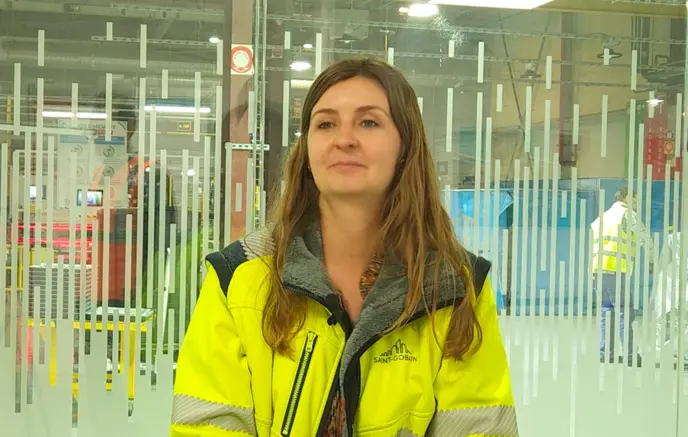
Saint-Gobain, a global leader in sustainable construction, has more than 600 sites worldwide and iconic industrial brands such as Isover, Placo, Eurocoustic, and Sekurit… Starting with an initial pilot site at Isover in Chalon-sur-Saône, Mercateam has gradually been rolled out across several of the group’s business units to digitize competency matrices, secure authorizations, and enhance the versatility of production teams. Here is the story of this rollout, as told by those who led it on the ground.
The Saint-Gobain Deployment at a Glance
| Group | More than 600 locations worldwide |
| Starting Point | Isover Plant in Chalon-sur-Saône (2023–2024), pilot site |
| Deployed Entities | Isover, then insulation plants, Eurocoustic, Placo, Sekurit |
| Isover Pilot | 160 employees plus about 20 temporary workers; the plant operates on a 5×8 schedule |
| BU Insulation | 2,500 employees, 10 plants, 450 managers |
| Key Uses | Competency matrices, authorizations and deadlines, on-the-job training, scheduling and versatility |
Starting point: the Isover plant in Chalon-sur-Saône
Background
The Isover plant in Chalon-sur-Saône, one of three Isover plants in France, produces glass wool for the construction, home appliance, and automotive industries. With 160 employees, about 20 temporary workers, and a 5×8 shift schedule, the plant never stops running.
«We have five managers with five different work methods, and our overall workforce management was lacking in efficiency. Today, we manage our skills using Excel tools.»
Iris Philips, HR Manager
In practical terms, the lack of a standard led to some very specific problems: data scattered across files that were too time-consuming to consolidate, duplicate training (with each trainer using their own methods, the same person could be trained twice for the same position), and schedule assignments made without certainty regarding each operator’s actual, up-to-date skills and authorizations.
The challenges: fostering versatility to remain competitive, standardizing practices among managers and across sites, ensuring reliable tracking of authorizations as they expire (CACES, medical exams, regulatory authorizations), and ensuring the safe daily assignment of teams.
The deployment
The rollout was carried out in workshops by an internal project team that included department heads: setting up workstations in Mercateam, creating training materials, and customizing the tool for field teams.
«Mercateam has brought a touch of Industry 4.0 to the site—true digital support, something new in the production environment.»
Iris Philips
On the ground, the change is tangible:
«Before Mercateam, we had a lot of problems with document archiving—a multitude of files that weren’t always up to date. Now, we monitor the actual schedule every day: when we assign people to a position, we know they’ve been officially trained and that they’ve held that position at least once in the last three months to maintain their proficiency.»
Yohan Guillain, Relay Station Manager
The assignment schedule is no longer a separate Excel file next to the skills matrix: it is the same tool, and each assignment is based on the employee’s actual skills and availability.
From a single pilot site to a multi-entity rollout
It is this approach that makes Saint-Gobain’s rollout so effective: a pilot site, proven results, and then gradual expansion.
«It started at a site in Châlons, and then we rolled it out to other sites. We were able to roll it out at Eurocoustic and Placo. It was clearly the catalyst for success that allowed us to replicate it across all insulation sites, and then at Placo. And now, it’s catching on elsewhere at Saint-Gobain.»
Three factors for success emerge from the testimonials:
- Dedicated and willing shopfloor pilots, with the full support of plant management.
- A collaboration between the shopfloor, IT, and HR, with a clear roadmap supported by the group.
- Pragmatic solutions for operators without digital access : tablets in the workshop, one email address per team, and QR code login to avoid having to enter any information.
Sekurit: Expansion into Automotive Glass
Sekurit, the group’s automotive glass subsidiary, faces a twofold challenge: automakers require skills validation for every production line, every product, and every position—that’s more than 200 skills to track—and one of its largest French sites has seen nearly 80 production workers leave in 18 months, representing one-third of the workforce over two years.
The solution combines physical and digital elements. On one hand, there is a Skill Center—an in-house training school shared by the three French plants and serving 600 employees—which has cut the training time for backup personnel in half. On the other hand, Mercateam was rolled out as a pilot at one plant to digitize certifications: the teams recertified all skills in the tool to start with a clean, traceable database.
The most telling finding from the audits of automakers:
«Where we used to spend 20 minutes explaining our Excel spreadsheet and searching for documents, we can now cover the topic in 3 minutes. It’s not even an issue in audits anymore.»
Claire Billas, HR Manager and Head of the Skill Center France, Sekurit Noyon
The 2026 goal: to create a comprehensive maintenance training program and migrate all Skill Center tracking to Mercateam to standardize practices across the three plants.
🎤 Read Claire's full testimonial in the summary of the panel discussion from our 2025 Community Event.
How Mercateam Is Making a Difference Every Day at Saint-Gobain
- A shared vision of skills. «For me, Mercateam’s greatest value is its shared vision—a common, big-picture perspective.» (Yohan Guillain, Isover)
- Authorizations under control. The tool automatically flags expired authorizations and those about to expire, whereas previously it was necessary to send follow-up emails to the HSE and HR departments.
- A structured and self-directed on-the-job training program. Field teams manage training through their own representatives (shift supervisors, instructors), with supporting documentation available for audits.
- Versatility as a driver of performance. Assignments are based on actual, up-to-date skills—including across teams—with versatility cycles tracked over time (holding a position regularly to maintain proficiency).
- Anticipating skills needs. Mapping helps identify future needs and initiate training before production is affected, which has a direct impact on the level of temporary staffing required—a goal the group monitors on a site-by-site basis.
- A group standard that remains practical for the field. Each site tailors its positions and career paths while standardizing practices—a key challenge for a multi-site group.
A Word from Leadership: Saint-Gobain Isolation’s HR Vision
Mathieu Sanguinetti, HR Director at Saint-Gobain Isolation, leads a business unit with 2,500 employees, 10 plants, and 450 managers. As a guest on the "Dimensions RH" podcast alongside Adrien Laurentin, CEO of Mercateam, he describes the big-picture view: that of an HRIS designed for the front lines (English subtitles available in the settings).

A unified vision, from the site to the group
«As the HR director of a business, I now have a single view—through a single tool—of what’s happening across all the industrial sites under my purview. And at each site, managers, HR, and senior leadership also have a comprehensive view of their respective units.»
This consolidation directly supports the group’s workforce planning and development strategy: mapping current skills, identifying roles facing labor shortages (with maintenance at the top of the list), and creating clear career paths for operators, from the least skilled to the most skilled positions.
Empowering Front-Line Managers
According to the HR director, front-line managers have «probably the most difficult job in the organization.» The organization stands by this choice:
«It’s the manager who keeps track of skills, versatility, and job training. HR is there to coordinate and supervise. But it’s the manager who makes it a tool for everyday use.»
This principle was applied starting with the pilot project in Chalon-sur-Saône, where a team leader was involved in the planning process from the design phase onward—one of the key lessons learned from the rollout, according to the two guests.
A factor that makes it attractive to younger generations
«A young person who walks into a factory with a tablet, scans a QR code to get training, and sees the work schedules on screens—which are more up-to-date than the paper versions—… that makes a difference.»
The digitization of skills management helps modernize the image of factory work, which is a direct recruitment challenge for the industry.
Saint-Gobain's Tips for a Successful Group-Wide Rollout
- Start with a pilot site and accept that this first site will take some time: it’s the one that speeds up all the others.
- Selecting Volunteer Field Pilots, visibly backed by plant management.
- Dare to Change : «Mindset accounts for at least 80 % of the final performance. We dared to change.»
- Remove barriers to connection for operators with simple solutions: tablets, team accounts, QR codes.
- Make collaboration between field operations, IT, and HR a prerequisite, not a consequence.
FAQ
Which Saint-Gobain sites and brands does Mercateam use?
The rollout began at the Isover plant in Chalon-sur-Saône (glass wool), a pilot site, before being replicated at other insulation sites—at Eurocoustic and Placo—as well as at Sekurit (automotive glass) starting with the Noyon plant.
Why did Saint-Gobain choose to roll out the initiative through pilot sites?
To demonstrate value within a controlled scope before scaling up. The pilot project in Chalon-sur-Saône served as a catalyst for all subsequent rollouts across the group.
How is Mercateam used at Saint-Gobain?
Digitized competency matrices standardized across sites; tracking of authorizations and their expiration dates (CACES, medical exams, regulatory authorizations); on-the-job training tracked and managed independently by field staff; and oversight of cross-training and scheduling.
How do operators without an email address log in to Mercateam?
Saint-Gobain has set up tablets in the workshop, each with a team-specific email address and QR codes that can be scanned to log in without having to enter any information. This system has removed the main barrier to digital access for production teams.
What results has the Saint-Gobain Group achieved with Mercateam?
A shared, up-to-date view of skills among managers and across sites; authorizations monitored with expiration alerts; significant administrative time savings for HR and team leaders; and streamlined audits: At Sekurit, the skills component of manufacturer audits has gone from 20 minutes of justification in Excel to 3 minutes, with supporting evidence available directly in the tool.