

Mercateam and Shizen are partners, and integration between the two platforms is available.
At most industrial sites, the morning briefing and skills management are handled in two separate tools. The team leader runs the meeting in one, then checks the other to see who’s present, who’s trained, and who can cover a position. This integration brings both together in one place: on the screen the team is already looking at. Here’s what it enables, how it works, and who it’s designed for.
Two shop floor tools that stop ignoring each other
Shizen is a French platform designed to optimize industrial performance. Mercateam is the platform for managing skills, authorizations, and job assignments for production teams. We don’t do the same thing, but we serve the same people, and several industrial sites are already using both platforms—separately—on two different screens.
This partnership stems from an observation we hear at nearly every site we visit: field teams don’t want yet another tool. They want the tools they already have to stop ignoring each other.
The starting point: the proliferation of tools at the workstation
Recently, during a meeting at a manufacturing company, the performance manager described a typical day for one of his operators. A problem arises at a workstation. The operating procedure is in one system. The maintenance request is in a second system. The progress update is in a third system. Time tracking is handled in a fourth system.
His conclusion is worth quoting verbatim: we need to unify, but not necessarily with a single tool. We need a single interface for the person in front of the screen.
Why we don't try to do everything
The obvious solution to the proliferation of tools would be a single platform: one software application for quality, safety, maintenance, skills, scheduling, and training.
In reality, this model rarely works. A tool that covers ten areas only covers each one halfway. Teams run up against limitations when it comes to their actual needs, find workarounds, and go back to Excel. We regularly see sites where a license has been paid for over the years without being used, because the tool didn’t do any of the things it was purchased for properly.
We took the opposite approach: focus on one thing and work with those who do the rest well. Shizen took the same approach. They could have developed their own skills management module. Instead, they chose to partner with a tool that specializes in this area, rather than providing their clients with yet another module to maintain that would yield only approximate results. It is this choice that makes this partnership possible.
What Shizen does
Shizen is the platform for day-to-day performance management on the shop floor, used by the production teams themselves.
A team leader uses it to build a dashboard of metrics, populated manually or automatically from the ERP, MES, or a BI tool. He uses it to launch his sequenced team rituals, floor rounds, and safety audits; even offline when the shop floor network is down. Operators use it to report incidents and issues, with supporting photos, and these reports directly feed into the next team meeting. Problem-solving is structured using methods the teams are already familiar with—the 5 Whys, QQOQCP, Ishikawa, and 8D—and action plans are escalated from one level to the next according to rules defined by the site.
In a nutshell, it is a tool for day-to-day performance management.
What Mercateam does
Mercateam manages the skills of field teams and their assignment to positions: versatility matrices, authorization tracking and their expiration dates, job training program, instructions available directly at the workstation work schedules and daily assignment of operators, taking into account who is present, who is trained, and who is authorized.
In a nutshell, it’s the tool that answers the question: Who can fill this position tomorrow morning?
How to display Mercateam in Shizen
The integration is available, and implementing it requires no technical work.
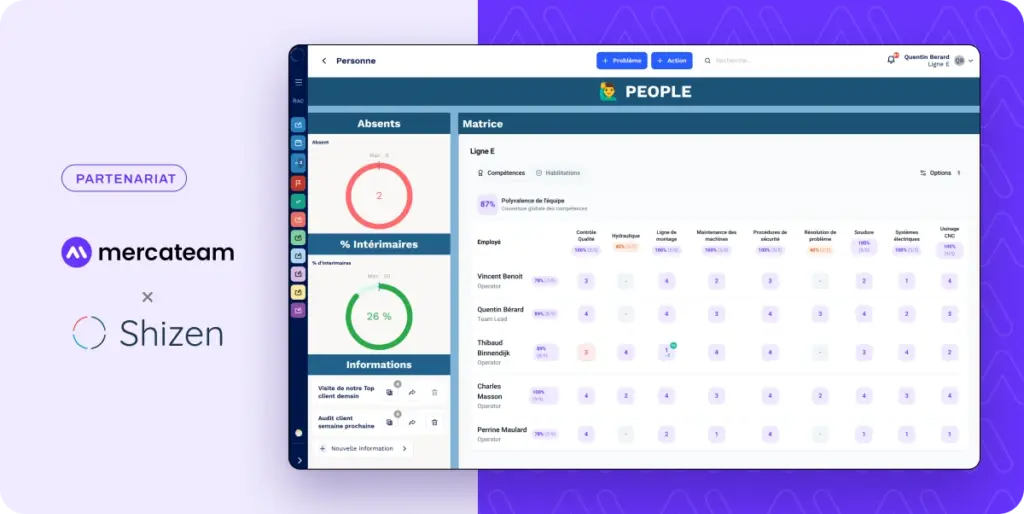
In Mercateam, from a skills matrix, a schedule, or an absences view, a menu allows you to generate an integration link. In Shizen, simply add a visualization widget to a daily management page and paste that link into it. The Mercateam element then appears directly on the page, in the exact location where the team meets.
|
Set up in just a few minutes Without an IT project |
||||||
|
Four types of elements can be included:
- Polyvalence matrices and authorizations. Who holds which position, at what level, and which clearances are nearing their expiration dates.
- Absences and availability. Who is present, and how that affects workstation coverage.
- The assignment schedule. The assignment board, built on actual skills rather than habits.
- Content and training. Procedures, job standards, and resources related to the team.
The integration also works with the free, simplified version of Mercateam. A site that already uses Shizen can therefore display its skills and authorizations in its day-to-day operations without first obtaining a Mercateam license.
Why these two areas would benefit from collaborating
Because they all come together every day, at a specific time: the first five minutes of the briefing.
Two questions come up time and time again: Who is present this morning? And if someone is absent, who can cover their position? At most sites, these two questions are handled off the top of one’s head, or on a piece of paper, or in a file that someone updates whenever they think of it. The decision is made, but it’s rarely documented, and in six months, no one will know that the position was filled that day by someone whose qualification was about to expire.
The second intersection occurs later, when a quality issue arises for a third time at the same workstation. There are often two causes: a machine malfunction and a procedure that the assigned employee had not yet mastered. Day-to-day shop floor management sees the symptom. Skills management addresses the root cause.
Lack of competence: just another kind of gap
In short interval management, every issue follows the same path: it is identified, a course of action is decided upon, it is assigned, it is escalated if the current level cannot handle it, and it is tracked until resolution. The loop closes during the meeting.
Except for one issue. When the problem identified is a lack of competence or authorization, the loop is never closed on the spot. You have to exit the tool, write to someone, and wait for a response. In practice, the finding is noted and then forgotten, until it resurfaces during an audit or an incident.
This explains a phenomenon we see everywhere: the competency matrix is accurate on the day of the audit—and only on that day. Between audits, an operator logs hours on a machine without having their proficiency validated, a certification expires without anyone noticing, and the day before the auditor arrives, someone spends two days bringing everything up to date.
The problem is neither the skills management tool nor the facilitation tool. It’s that updates never happen when the information is available—that is, on the ground, during the briefing.
Linking these two tools brings skills back into the problem-solving loop. A missing qualification ceases to be a separate issue and becomes a discrepancy like any other, visible the moment it occurs. The matrix ceases to be a document updated before an audit and becomes a tool for day-to-day management.
We've already explained how to identify skill gaps company-wide. What we’re describing here is the other end of the chain: the moment when the shortage is noticed on the shop floor.
Traceability remains with Mercateam
That's the first question a quality manager asks, and it's a legitimate one.
Integration does not move the data. Skills and qualifications remain in Mercateam, along with the associated user identification, access rights, and history. Shizen provides a view of this information right where teams need it. The integration creates no copies, no duplicate data entry, and no alternative approval paths.
One site is already using both platforms
A factory in the Richemont Group has been working with both tools for several years, each on its own. An interesting detail: the project manager for Shizen and the project manager for Mercateam are the same person.
On the Shizen side, operations are structured across several levels, from daily field briefings all the way up to the executive committee, with an escalation process between levels. On the Mercateam side, usage is centered on skills: a versatility matrix, workshop standards linked to skills, alerts for certifications nearing their expiration dates, and QR codes at workstations.
Two mature systems, and so far, no bridge between them. It is precisely this gap that integration fills.
Available now
This integration is primarily intended for sites that already use both platforms, as well as Shizen customers whose “People” module remains based on self-reported information and who are looking to populate it with actual data.
If your site uses Shizen and questions arise regarding skills, authorizations, or job assignments, or if you are a Mercateam client and are looking to organize your field operations, let's talk about it.
Shizen is the French platform for driving industrial performance
SQDCP, SIM, field visits, audits, and problem-solving.


