
An operator may have fifteen years of experience and impeccable machine setup skills, yet struggle when it comes to training a temporary worker, reporting a quality defect in writing, or getting to grips with the new MES system deployed on their line. The technical skills are there, but something else is missing: the cross-disciplinary skills, these skills—which do not depend on any machine—are playing an increasingly important role in a workshop’s performance. With the digitization of workstations, the pressure for versatility, and the accelerating pace of retirements, these skills now determine a site’s ability to weather unforeseen challenges. The question remains: which skills really matter, how can you identify them in your operators, and where should you start to help them develop?.
What are cross-functional skills in industry?
Two operators may hold the same position, have the same clearance, and have the same length of service, yet one stays the course when things go wrong, while the other gives up at the first sign of trouble. This difference lies in skills that aren’t listed on any job description.
How do they differ from technical skills?
Each operator has mastered the specific tasks associated with their position, from machine setup to welding, including production line operation and quality control. These technical skills, or “hard skills,” are directly related to the job. Transferable skills follow a different logic, as they can be applied in a variety of contexts regardless of the position or industry. France Travail describes them as generic skills related to basic knowledge or behavioral, cognitive, and organizational abilities. In production, this translates very directly into the ability to resolve an unexpected problem on a production line, to provide clear instructions during shift changes, or to switch from one position to another overnight.
Céreq categorizes these skills into four groups: intellectual (analysis, critical thinking), interpersonal (teamwork, communication), organizational (time management, prioritization), and adaptive (flexibility, stress management). For a production manager, this distinction has very direct implications, because an operator can be technically excellent yet pose a problem as soon as they have to work in a pair or report information without the team leader’s intervention. If you supervise a production line, you probably have one or two such employees in mind. Technical skills can be checked off on a certification, soft skills are only evident in practice, and their combination determines a team’s day-to-day performance.
Why are these skills becoming increasingly important?
First reason: technological acceleration, which shortens the lifespan of purely technical skills.
An operator trained on a specific piece of equipment must retrain every time the tool is updated, a new MES is deployed, or when field tablets replace paper forms. At many sites, this means a change in the user interface every two to three years, and each transition puts part of the shop floor back into a learning phase.
In this trend, the skills that enable people to learn quickly, adapt, and collaborate form a more enduring foundation than any single skill, to the point that the’skills obsolescence Technical issues are becoming a management challenge in their own right.
According to Deloitte, the manufacturing sector could face a shortage of 1.9 million workers by 2033 due to a lack of sufficient effort in skills development. And the jobs that are being created most rapidly combine technical expertise, digital proficiency, and soft skills. Recruiting or training based solely on job-specific skills is therefore no longer sufficient, which explains why GPEC and GEPP initiatives now include cross-functional skills in their frameworks, alongside technical qualifications.
Key Cross-Functional Skills in Industrial Production
Not all of them are created equal on the production floor. Four of them come up again and again in the feedback we receive from the manufacturers we work with, because they determine what happens when the day doesn’t go as planned.
The 4 Cross-Curricular Skills the ones that really matter
Click on a map to view A concrete example from production.
Problem solving and critical thinking
This ability is based on critical thinking—the ability to evaluate information, question assumptions, and make decisions, even under pressure. Lean and continuous improvement approaches, in fact, rely on this autonomy among the operators themselves, not just among process engineers.
Adaptability and agility in the face of change
This flexibility goes hand in hand with the multi-skilling, this ability to perform multiple roles within the same production area. It also requires an openness to change—something that doesn’t come naturally, especially for experienced employees who are faced with methods they did not choose.
Communication and teamwork
On the ground, many of the morning’s mishaps can be traced back to instructions given hastily the night before or scribbled in the corner of a notebook. The numbers confirm this, since 31 % Manufacturing companies rank communication as the top soft skill they expect from their new hires.
Digital skills and culture
Entering data into an MES, viewing a schedule on a tablet, interacting with a cobot, and reading a real-time production dashboard: these tasks are now part of daily life in a growing number of factories. No computer science degree is required, but a basic level of digital literacy is essential—and not all operators have acquired it yet, starting with the most experienced ones. When the system malfunctions, the notebook comes out of the pocket and data is entered from memory at the end of the shift, which undermines the reliability of production data. The Europe 2020 Strategy had already identified digital skills as a priority for employability. In industry, the challenge plays out at the workstation, since it is the workstation that determines whether a tool deployed at great expense is actually adopted or circumvented.
Why does Industry 4.0 make these skills critical?
The shift toward Industry 4.0 is not initially evident in robots, but rather in the digital interfaces being added to the workplace.
Jobs That Are Becoming Digital
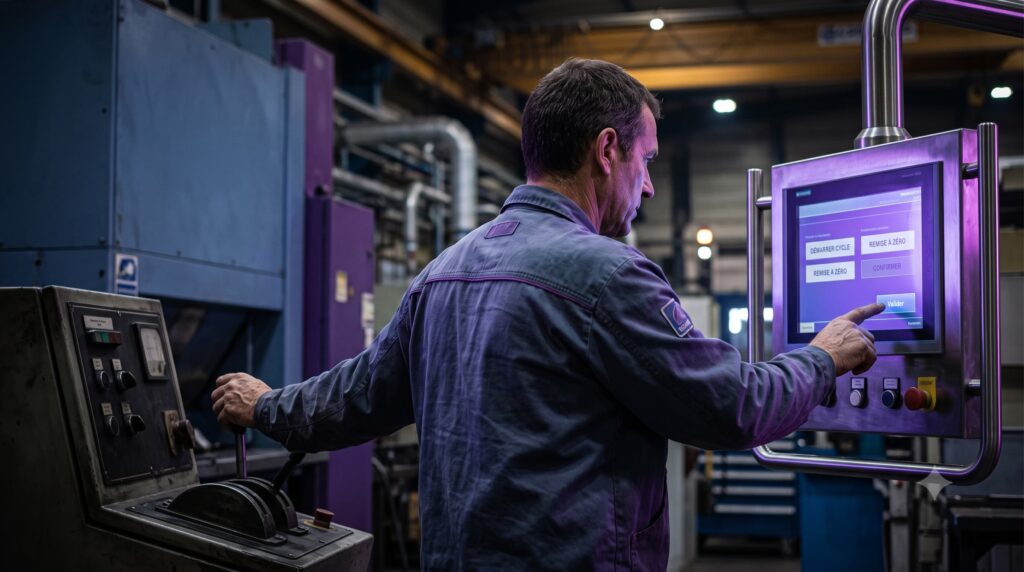
The operator who was manually controlling his machine five years ago now interacts with a touchscreen, scans QR codes to access instructions, and reports production data in real time. The global smart manufacturing market nearly reached 340 billion dollars early 2026, which gives a sense of the transformation currently underway in the workshops. For the teams, this digital transformation presents a two-pronged challenge: on the one hand, knowing how to use the tool; on the other, understanding why it is used, adapting to it as it evolves, and reporting malfunctions in a structured manner rather than waiting for a colleague to handle it. In the aerospace industry, where every action must be documented for the NADCAP audit, an incorrectly entered data point directly jeopardizes the batch’s compliance. The first aspect is technical; the second is cross-functional—and it is the latter that is most often lacking.
Versatility and internal mobility, a competitive challenge
Cross-functional skills directly contribute to the versatility of teams. An operator who communicates, adapts, and solves problems learns a new role faster than someone with a purely technical background, no matter how skilled they are on their machine. When recruitment challenges affect 44 % of operator positions in the food processing industry—and even more so in maintenance—developing internal mobility is just as important as investing in machinery.
This is a conclusion we share after having equipped more than 300 industrials. Companies that truly focus on developing their operators’ cross-functional skills are better able to handle production disruptions, last-minute absences, and seasonal peaks—simply because their teams can quickly reposition themselves without compromising on quality. If you’ve ever had to fill a scheduling gap on a Monday morning using whatever resources were available, you know exactly how valuable this ability to adapt is.
How can you identify your teams' cross-disciplinary skills?
Before you develop anything, you need to know where you’re starting from, and that begins with bringing to light skills that, by their very nature, aren’t easily seen.
Mapping skills in a matrix
It all starts with a framework that lists, alongside the usual technical skills, the cross-functional skills expected for each position. This framework feeds into a skills matrix where you can see, for each operator, their level on each item—whether technical or behavioral. The analysis reveals two key insights. First, it highlights collective strengths: many adaptable profiles, a strong communication culture, and well-distributed digital skills. Second, it sheds light on blind spots, such as a lack of communication between departments or a digital culture concentrated in just a few roles. This factual foundation allows you to prioritize your actions rather than spreading them thinly across poorly prioritized needs. The first matrix a site creates almost always reveals the same surprise: critical expertise that rests solely with two or three people—sometimes just one who is a few months away from retirement.
[Image, explanatory diagram : A visual representation of a competency matrix with operators listed in rows and competencies (technical and cross-functional) listed in columns, along with proficiency levels, to illustrate the concept described above. Image prompt: a minimalist editorial diagram of a competency matrix, with operator names in rows and competency titles in columns, cells colored by proficiency level (scale 1 to 4), in a simple industrial infographics style, with a light background and high readability.]
Assessing soft skills in the field
Assessing a cross-functional skill requires more finesse than validating a qualification, where a test or certification settles the matter. Here, observation in a work setting remains the most reliable method. How does the operator react when his machine breaks down in the middle of a production run? How do they brief the next shift? How do they handle a disagreement with a coworker about the correct way to proceed? Performance reviews and feedback from team leaders complement observation, provided they are based on structured rubrics that objectify the assessment. A useful rubric fits on one page and describes observable behaviors rather than abstract qualities: «resumes production on their own after a common glitch» is rated; «is thorough» is not. Without this framework, you fall back on subjective impressions and their inherent biases. The stakes are far from theoretical, since more than 80 % from manufacturers acknowledge that their candidates lack basic yet critical skills, which makes it all the more important to identify these gaps early and address them in the right setting.
How Can We Develop Cross-Functional Skills in Production?
Once the photo is taken, it’s time for action—that’s where these skills are really put to the test, on the field.
Targeted training and learning by doing
Cross-functional skills are best developed through hands-on experience. An experienced operator who takes a newcomer under their wing, a continuous improvement task force, or a supervised job rotation designed to build adaptability—these are the true learning environments. Some skills-based training structure this skill-building process by focusing on the specific work skills required for each role, rather than a generic list of skills. Workshops on communication, problem-solving, and emotional intelligence are gaining ground in the industry, with measurable results. Supervised mentoring often pays off more than a day in a classroom, provided that the mentor is given sufficient time and isn’t assigned five new hires at once.
At Mercateam, we’ve seen sites cut their training time by 75 percent thanks to more targeted and well-equipped training programs, which addresses the most common objection: a lack of time for training.
Building a structured development plan
Developing a process on the fly, in response to emergencies, quickly reaches its limits. To ensure long-term sustainability, formalize the process in a skills development plan that combines hard skills and soft skills, with specific deadlines and regular follow-ups. This plan aligns training efforts with your operational priorities—identifying which cross-functional skills are most lacking, in which roles, and what risks arise if no action is taken—and it measures progress over time rather than leaving you to wing it. If there’s one principle to remember, it’s this: what isn’t tracked doesn’t develop.
At sites where these skills are systematically mapped, assessed, and developed, day-to-day production runs more smoothly, with more reliable handoffs, less disruptive line reorganizations, and faster adoption of new tools. As Industry 4.0 transforms the workplace, these skills form the foundation upon which a site’s sustainable performance is built. Manufacturers who embrace them now gain a head start over those who continue to focus solely on technical skills.
Map and develop cross-functional skills teams' versatility
Place hard and soft skills on the same matrix, identify blind spots, and track skill development over time. Your teams will become more versatile, and your production will become more reliable.
Book a demo