
It takes an average of four to six weeks to train an operator to work independently on a food production line, and this timeframe increases even further during peak season when a single trainer must mentor ten new hires at once. Of the 300 industrial sites we serve, several plants have reduced this timeframe to ten days without compromising safety or quality. The method consists of five key elements and a change in the sequence of the training program.
Why does it take an average of 4 to 6 weeks to onboard an operator?
Long onboarding times are almost never caused by an overly intensive training program, but rather by a buildup of administrative bottlenecks: QHSE waiting for HR’s availability, on-the-job training waiting for a slot with the mentor, and authorizations sitting on a desk for three days before being signed. All told, these delays often account for more than half the time it takes to start a new position, and their cost remains hidden because no single department is truly responsible for them.
A trainer who spends four hours a day mentoring a newcomer—that’s half a day less production on its own line.
According to the’Sapiens Institute, each unproductive day costs an average of 180 euros per operator, and the indirect cost of replacement amounts to 120 to 150 % of the usual salary. When multiplied by three or four new hires arriving at the same time, the slowdown becomes measurable in terms of the plant’s weekly output.
The agri-food industry sees all these pressures converge at the same time of year. In fact, the sector employs 9 % of its workforce through temporary agencies and alone accounts for a quarter of all temporary workers in French industry. Every summer, thousands of seasonal workers arrive at processing plants within a matter of days, and the commitments made by companies like Bonduelle and Valrhona to their customers leave no room for a peak production period to be delayed by a week due to a bottleneck in onboarding.
Going from six weeks to ten days
A food processing plant with 300 workers, whose business peaks from June through September, followed the traditional approach before revamping its onboarding process:
- Day 1 of HR Orientation
- two days of QHSE classroom training
- followed by three to four weeks of working double shifts with sporadic approvals.
On average, it took six weeks for an operator to reach the expected production pace, and several seasonal workers left before they had even been deemed self-sufficient.
Cut the time by two-thirds autonomy at the workstation
Mercateam structures the onboarding process for your operators, from QHSE pre-onboarding to signed practical validation. See how it works on your own production line.
Book a demo
The goal set for the next peak: to have every operator arrive already trained in site safety and logistics, so that on-the-job training can begin on Day 1. The first post-deployment season reduced the time to self-sufficiency to an average of ten days, and the trainer’s individual support workload was cut by four, allowing them to mentor three times as many new arrivals during the same time frame.
The benefit of this approach, quantified
Of the 300 industrial sites equipped with the system, several food processing plants have reduced the runtime to 6 weeks to 10 days, without compromising on safety or quality.
The Five Factors That Can Shift the Timeline
None of these measures alone is enough to cut the time frame by two-thirds: each one saves a few days on its own segment, and it is the cumulative effect of all of them that brings about the reduction in the total duration.
Move QHSE pre-onboarding outside of working hours
Safety, hygiene, and site logistics do not require a physical presence to be taught. A training course sent via a URL or QR code—accessible without a Microsoft account or prior installation—allows seasonal workers to complete these fundamentals from home or from their temp agency. On Day 1, the employee arrives with their ID badge, signed consent form, and completed QHSE quizzes, and the trainer moves directly to on-the-job training—saving two days of classroom orientation.
Digitize the training program on tablets at workstations
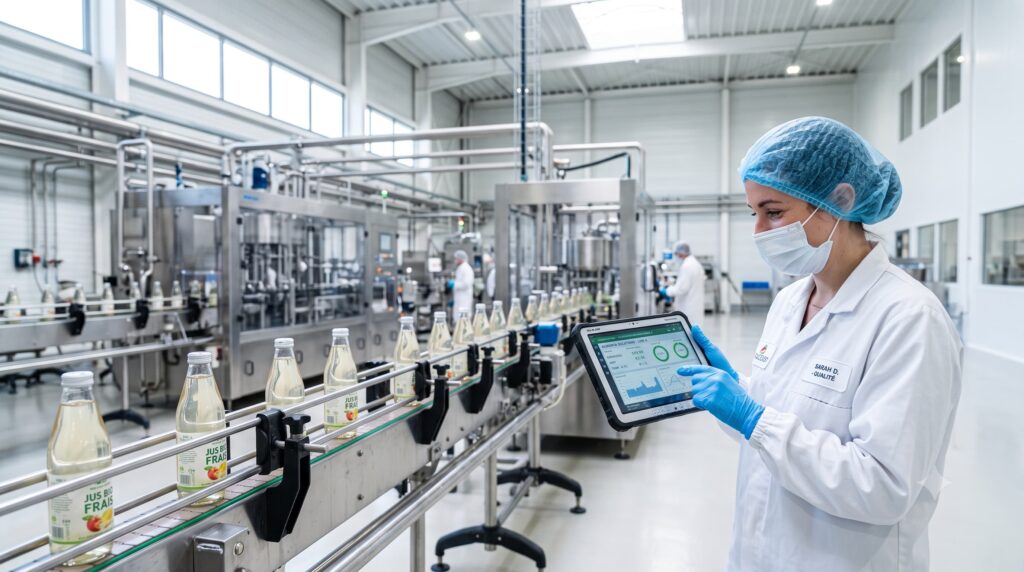
On the production line, the operator has a tablet containing videos, procedure guides, and quizzes to test their theoretical understanding of their specific workstation. They proceed at their own pace, independently verify what they have understood, and the trainer steps in only when they encounter difficulties. This approach extends the Training Within Industry method by freeing the instructor from having to give repetitive explanations so they can focus their time on hands-on practice.
Verify on-the-job training using a signed checklist
Simply knowing the procedure is not enough to know how to carry it out. Practical validation involves a checklist completed by a field evaluator, step by step, and electronically signed at the end of the session. It is this two-tiered approach (theoretical followed by practical) that ensures a smooth transition into the role: an operator can pass a line-cleaning quiz without knowing how to operate the machine. The time-stamped signature serves as proof of competence for NADCAP, ISO 9001, or IFS audits—areas where an Excel spreadsheet has long since become inadequate.
Update the skills matrix automatically
Each practical validation is sent directly to the skills matrix of the team, without the need for manual re-entry. The production manager can see in real time which lines can operate with the new hire and which are still awaiting authorization. The data becomes reliable, time-stamped, and enforceable, which also changes the company’s approach to audits. The same principle applies to the authorization management that expire and automatically trigger their renewal.
Start the onboarding process as soon as the new team member joins the team
The connection to the HRIS or HR ERP (SAP, Oracle, ADP) automatically assigns the onboarding process as soon as a new hire is created in the system. This eliminates the time gap between signing the contract and starting the first module, and ensures that no step is overlooked due to administrative oversight. This automation alone accounts for a four- to five-day difference between a well-equipped plant and one that still manages onboarding using spreadsheets.
Adapting the Method to Seasonal Temporary Workers
Temporary staffing in the agri-food sector has its own set of rules. Around thirty seasonal workers may arrive in the same week, sent by two or three different agencies (Manpower, Randstad, Adecco), for assignments that are too short to justify a lengthy onboarding process. Shared pre-onboarding addresses this exact scenario: the generic QHSE module is sent to the agencies, which distribute it to their candidates before they sign their assignment contracts. The plant receives an operator who is already up to date on site safety, without having to assign a single trainer beforehand.
The ability to track progress offers a second benefit. A seasonal worker who returns the following summer does not have to retake modules they have already completed: their history is linked to their user ID, and they pick up where they left off. In sectors where the same temporary workers return year after year (40 % cases in the agri-food industry, according to field reports), this mechanism significantly streamlines the start of the peak season. Our temporary worker management platform centralizes these paths and their history across assignments.
Measuring return on investment
An accelerated onboarding process is guided by five metrics that the production manager reviews weekly during peak periods:
- The average time between arrival and confirmed autonomy at the workstation, measured per operator.
- The pass rate on the theory assessment quizzes, which reflects the quality of the instructional content.
- The number of hours worked by instructors and tutors, compared to the same period last year.
- The line error rate during the first two weeks, compared to experienced operators.
- The rate at which seasonal workers return from one season to the next, an indirect indicator of the quality of hospitality.
Five metrics to track every week
What the production manager checks during peak hours. The values below are fictitious and are provided solely as examples.
Each indicator is compared to the same period in the previous year or to experienced traders, not in absolute terms.
In terms of funding, the digitization initiative is eligible for funding from sector-specific OPCOs: OCAPIAT for the agri-food sector and OPCO 2i for industry. The training activities associated with the program are part of the skills development plan, and several regions co-fund the initiatives that structure the onboarding of temporary workers. To track these indicators over time, see also our benchmarks on the training follow-up.
Reproduce the process in your factory
The first step is to map out the current situation: how many total hours does a new operator spend in training, who provides which training, and which modules overlap between corporate QHSE and site-level QHSE. The audit almost always reveals two to three days of redundancy and at least one in-person module that could be shifted to pre-onboarding.
The target architecture consists of three phases. Before arrival, we move everything that does not need to be physically on-site (generic QHSE materials, company presentation, internal regulations, and hygiene modules). On Day 1, we address what requires an in-person presence (facility tour, building-specific rules, team introductions). At the workstation, we conduct the digitized job training program, which includes self-paced theoretical assessment followed by practical assessment via a signed checklist. This structure, deployed both in the’agri-food ...which, in the aerospace industry, saves three to four weeks off the total lead time.
To see how these steps are implemented in a platform that is already active at 300 industrial sites, our onboarding solution The demo shows how it works in less than fifteen minutes.
See the method in action at your plant
From remote pre-onboarding to checklists signed at the workstation, discover how the platform adapts to your onboarding process, whether in the food industry or the aerospace sector.
Book a demo