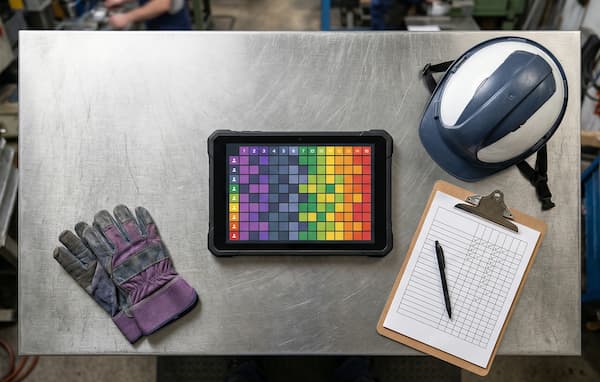

Most sites that call themselves lean have a skills matrix somewhere. An Excel file maintained by HR, updated before annual appraisals, built from job descriptions. The problem is that this tool is useless when the team leader has to decide on a shift rotation at 6 a.m. or compose the team for a kaizen site. A skills matrix lean is a different object: its columns are standardized operations, not HR headings. Its levels follow Toyota's ILUO system, not an abstract scale. And it lives in the gemba, not in a shared folder.
Why can't lean work without structured skills management?
The Toyota Production System is based on two pillars. The first is well known: continuous improvement, kaizen and the elimination of waste.
The second is less so, whereas the Toyota Way places it on the same level: respect for people and the development of everyone's skills. When the latter is neglected, the former ends up running on empty.
In the field, this is quickly apparent. Job rotation is provided for in the production plan, but it doesn't happen because only one operator masters the quality control station at the end of the line. A kaizen project is postponed because we can't get the right people involved in the operations concerned. Work standards exist, posted at the workstation, but when we ask the team leader who really masters them and who still needs support, the answer remains vague.
The skills matrix fills this gap. It makes visible, job by job and operator by operator, each person's actual level of mastery. In Lean, it's not kept in a drawer: it's displayed at the gemba and consulted every day to make staffing, training and rotation decisions.
What distinguishes a lean competency matrix from a conventional one?
The difference is not in the shape of the table, but in what you put in it and how you evaluate the operators.
A matrix focused on work standards, not job descriptions
In a lean environment, each workstation is defined by standardized operations, and it's these operations that make up the columns of the matrix. Not abstract HR skills like «team spirit» or «rigor». An operator is not assessed on his versatility in general: he is assessed on his ability to execute operation 3 of the assembly station according to the defined standard, within the planned cycle time, with the expected level of quality.
This approach changes the value of the matrix. Instead of copying job descriptions drawn up by human resources three years ago, we build the matrix by observing actual operations at the gemba, with the operators. The result is in line with what happens in the field, and that's why team leaders consult it on a daily basis, instead of letting it lie dormant in a shared file.
The ILUO system for assessing mastery levels
Lean manufacturing has its own skills assessment system: the ILUO. Each letter represents a level of mastery, and the number of strokes in the letter graphically illustrates the operator's progress.
- I (a vertical line): the operator is in training, knows the safety instructions for the workstation and works under constant supervision.
- L (two lines): the operator carries out the operation under normal conditions, respects the cycle time and identifies manufacturing faults.
- U (three strokes): the operator is autonomous, preparing his workstation, managing start-up and resolving routine anomalies in his operation.
- O (four strokes, the loop is closed): the operator can train others and suggest process improvements.
The system originated with Toyota and has since spread to the aerospace, automotive and manufacturing industries in the broadest sense. What makes it particularly interesting in lean is the «O» level: the operator who can train creates a direct link with the TWI (Training Within Industry), It's a loop where the person who masters a standard is also the one who passes it on. It's this loop that drives the continuous improvement of skills within a team, where a top-down training plan is not enough.
Compared to a conventional 0 to 4 scale, the ILUO also has a practical advantage: it is immediately visual and understandable by all operators in the field, without the need to explain how to read the matrix.
How the matrix feeds day-to-day lean projects
Job rotation and load smoothing
The rotation of operators between shifts is a pillar of the lean manufacturing versatility. It reduces monotony, prevents musculoskeletal disorders and builds a team capable of absorbing contingencies: unforeseen absences, production peaks, line breakdowns.
The matrix makes this rotation possible by clearly showing who is «U» (autonomous) on which shifts. The team leader who consults it in the morning immediately knows which rotations are feasible, and where the bottlenecks are. If only one operator is «U» on the critical welding station, the risk is obvious, and the training plan can correct this fragility before it causes a line stoppage.
This visibility is also linked to takt time: to respect the production rhythm, each shift must be manned by at least one «L» operator, and the matrix makes it possible to check this condition at each shift change.
Identifying critical skills before a kaizen project
Before launching a kaizen or 5S project in a production area, the first question to ask is: who in the team knows enough about the process to make a useful contribution? An improvement project staffed by people who have not mastered the operations concerned will produce superficial results.
The matrix can be used to select «U» and «O» operators for operations in the area concerned, but also to identify «I» and «L» operators who could benefit from the project to accelerate their skills development. In this way, kaizen also serves to develop people, not just optimize workflows. The PDCA cycle (Plan, Do, Check, Act) applies to skills in the same way as it does to processes: skills development is planned, training is carried out in the field, progress is checked using the matrix, and adjustments are made.
Build your lean skills matrix in 4 steps
We don't need to start from scratch, but we do need to change our method: start from the ground up, rather than from existing documents.
Define a skills development plan in line with the site's lean objectives. Each training action must respond to a weakness identified in the matrix. Priority is given to critical positions and at-risk skills, and the plan is reviewed each quarter in line with the lean projects scheduled for the period.
Map standardized operations by item. Go to the gemba and observe the actual operations at each workstation, with the operators. Don't copy existing job sheets: list the operations as they are performed, with their associated work standards. These operations will form the columns of your matrix.
Evaluate each operator using the ILUO scale. Evaluation is carried out in pairs, with the manager observing and the operator self-assessing. Differences between the two are valuable signals: an operator who rates himself as «U» when his manager sees him as «L» reveals either a poorly calibrated standard, or a need for further training.
Visualize areas of fragility. Once the matrix has been filled in, certain risks become obvious: jobs where only one operator is «U», critical skills held by people close to retirement, entire lines without an in-house trainer («O»). These weaknesses directly determine the priorities of the training plan.
Excel or digital tools: which support for a living lean matrix?
In lean, a skills matrix is only as good as its current reality. After each training session, each job rotation, each departure or arrival, it has to be updated, and this is where many industrial sites fall down.
With Excel, updating is manual and error-prone. Beyond a few dozen operators, the file becomes difficult to maintain, and expiring authorizations fly under the radar.
A digital tool dedicated to industrial skills management solves these problems: immediate updates, automatic notifications of expiring authorizations, real-time access for team leaders directly at the workstation. On the 300 industrials that we support at Mercateam, the transition from Excel tracking to a dedicated skills management tool cuts the time spent on skills management by a factor of four, while improving data reliability for audits.
For a 20-person workshop with one production line, one well-structured Excel matrix may suffice at first. Beyond that, or as soon as rotation between lines becomes an issue, the digital tool takes over.
What changes on a daily basis is that the team leader can open his matrix in the morning and see the coverage of his workstations at a glance. Rotation is planned in a matter of minutes, the team for a kaizen job is put together by cross-referencing ILUO skills with process requirements, and operators see their own progress, making the skills enhancement tangible for them too. The matrix is no longer a file to be filled in for an audit: it becomes the tool that drives continuous improvement on a daily basis.