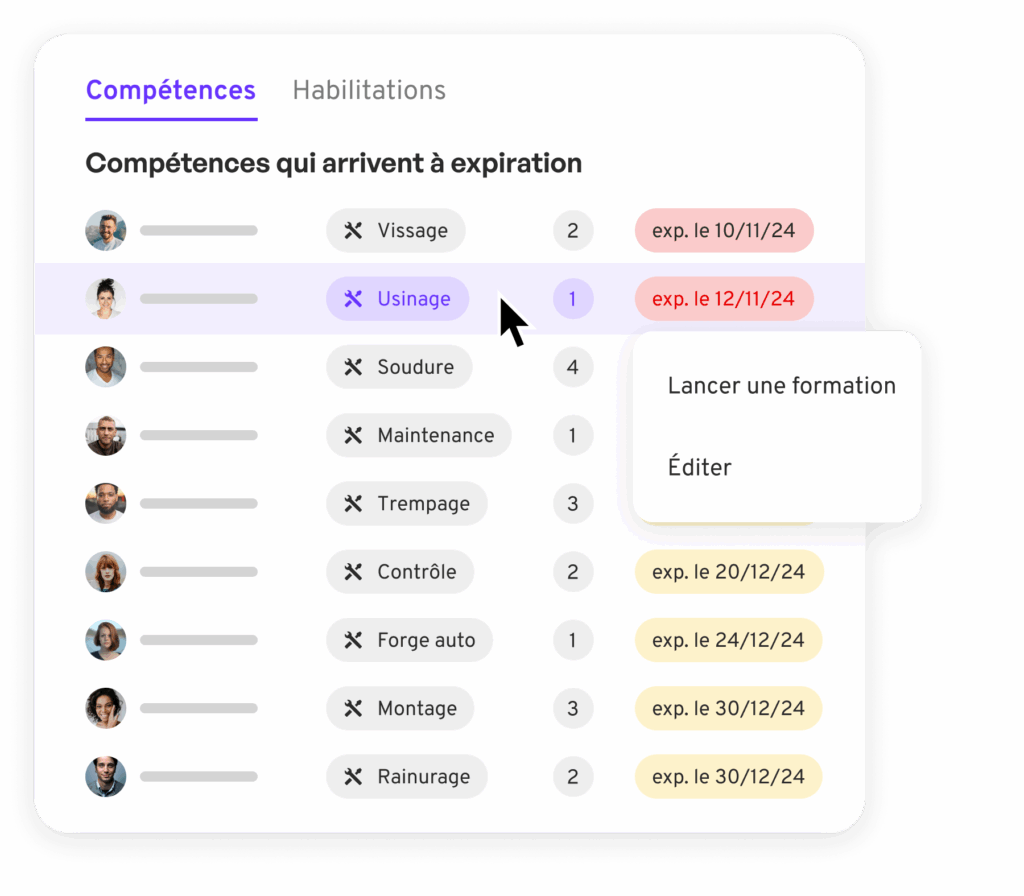
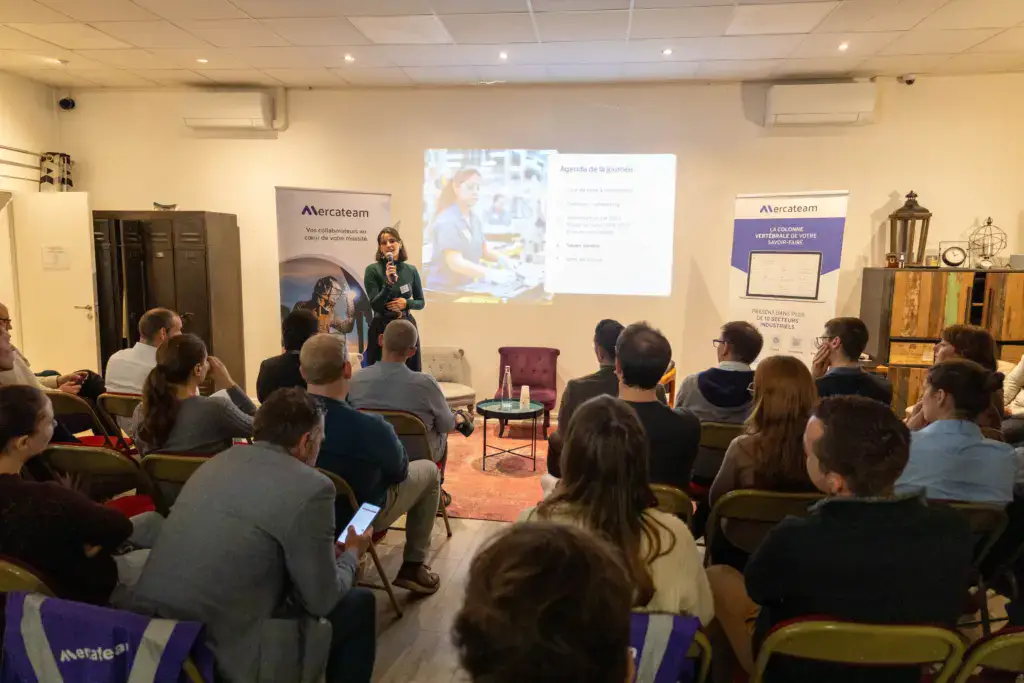
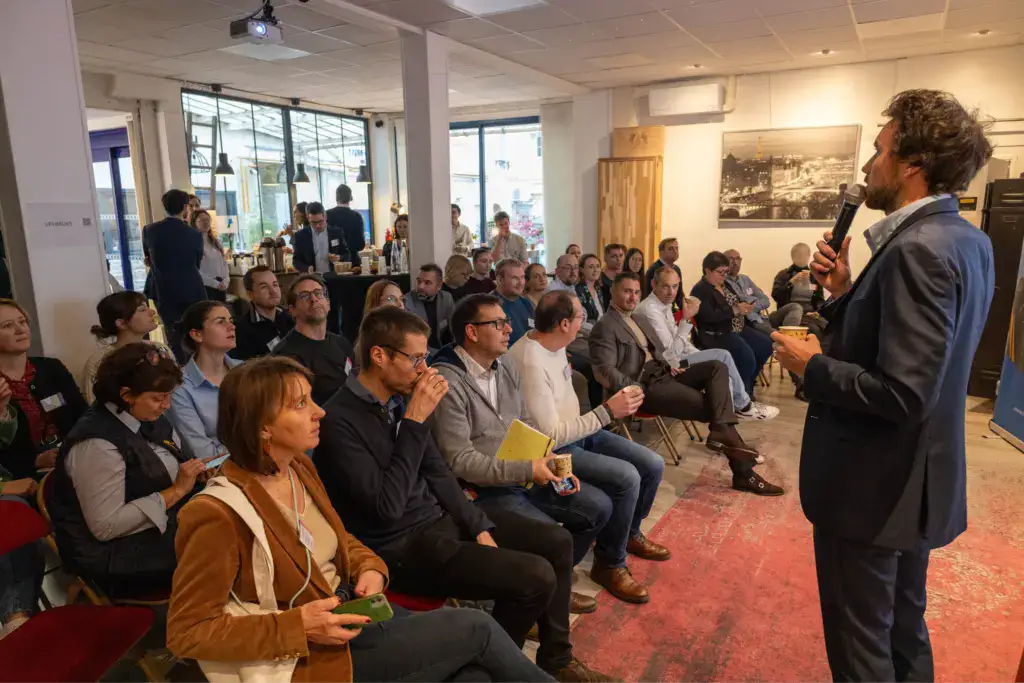
On November 20, Mercateam organized its Community Event 2025 : an annual event that brings together industry players to discuss issues related to skills and expertise management. This year, the event focused on’operational excellence through an inspiring round table discussion: « When mastery of skills becomes a competitive advantage" .
To provide concrete insights to the 50 decision-makers in attendance (industrial directors, quality managers, production managers), Léa Moreau, Head of Implementation at Mercateam, had the pleasure of leading an informative discussion with distinguished guests who shared their experiences.
At his side:
- Claire Billas, Skills Centers France Coordinator, Saint-Gobain Sekurit,
- Romain Le Bihan, Continuous Improvement Manager, Richemont Group,
- Julien Peillon and Sandra Grange, Team Leaders, Sigvaris Group.
Claire manages 600 employees in three windshield factories. Romain manages continuous improvement in the luxury metallurgy sector. Julien and Sandra supervise 128 operators manufacturing medical devices. Three sectors (automotive, metallurgy, medical devices), three realities, one observation: traditional skills management methods no longer work.

What is operational excellence?
Before diving into the testimonials, let's clarify the concept. Operational excellence refers to an organization's ability to deliver quality products while optimizing its resources. It has its roots in the Toyota Production System of the 1950s, which gave rise to the Lean management.
But beyond the academic definition, what does it mean in the field? Romain, Continuous Improvement Manager at Richemont, makes the diagnosis:
«When we talk about the four performance areas of a company—safety, quality, costs, and deadlines—a person working in a non-standardized position may perform a task in a way that puts themselves at risk. They may work quickly, but not produce quality work. Their colleague will do the opposite. Today, we are able to standardize and eliminate this variability.»
Operational excellence is precisely that: reducing variability in practices to ensure consistent performance. And this approach begins with one fundamental element: knowing who knows how to do what.
«We had 80 departures in 18 months»: when urgency forces transformation
At Sekurit, a Saint-Gobain subsidiary specializing in automotive glass, Claire experienced a scenario that many manufacturers dread. At the Thourotte site, a third of the workforce left in two years.
«On the production line, we had almost 80 departures in 18 months. We knew we couldn't do the usual training of replacements. For line operator positions, it takes about six months. In this case, six months of training replacements was not feasible. We couldn't have three, four, or five people working with our operators.»
The situation was all the more critical because those leaving were the most experienced employees—those who had accumulated 30 years of expertise. The solution? Create a Skill Center, a dedicated in-house technical training school.
The result was immediate: the training time was halved. New arrivals now spend two weeks in structured training before joining the production lines. When they arrive on the job, they already know the vocabulary, codes, and principles of the machines.
«When the audit was approaching, it was panic time»: regulatory pressure as a trigger
At Sigvaris, a manufacturer of medical devices (compression stockings and tights), the trigger was different. Julien and Sandra, both team leaders, manage 128 employees who are subject to the strict requirements of ISO 13485.
«The audit is in March. When January comes around, we go to the workshops, we go everywhere, we look for the right file. It was stressful for us, stressful for the operator.»
The problem was twofold. On the one hand, paper documents scattered, lost, or thrown away over the years. On the other hand, quality audits which require proof that every operator handling the product has been properly trained.
Sandra describes the situation before:
«Training was done on paper documents, and validation was all archived in binders. Automatically, over the years, when our employees left or returned, documents were thrown away or misplaced. It was difficult to prove that people had actually received all the training.»
Today, with a structured skills management system, the team approaches audits with confidence. Each operator follows a defined training path, validated step by step. In 10 days, a newcomer is trained with the assurance that he has seen all the required content.
«It was all in people's minds»: when standardization is at stake
At Richemont, the motivation was different. No massive wave of departures, no immediate audit pressure. But a lucid observation by Romain:
«We didn't really have any regulatory issues or pressure to manage skills. But we had managers in the field who, when it came to ‘who knows how to do what,’ had everything in their heads. And I had as many ways of doing things in the workshops as there were people.»
The issue of standards perfectly illustrates the challenge. When they did exist, they were often «stuck in server limbo, difficult to access even for administrators.» For operators, it was mission impossible.
The anecdote that started it all:
«I took an operator out of his workshop to have him document all the standards for a workstation in Word. It took him three and a half weeks for a single workstation. We thought to ourselves: we have X workstations here, that's going to take billions of hours. It's not possible.»
The solution was radical: switch to video. A GoPro camera was mounted on the head of an expert operator, who described his approach. The result: a day and a half to document a position, compared to nearly a month ago. And much more engaging training materials.
Three different approaches, one common foundation: structuring skills
The three companies took different paths, but all converged on the same starting point: a clear, up-to-date skills matrix.
At Sigvaris: the structured training program
Julien explains the transformation:
«Before, when an operator arrived, we would put them on the job and tell them: take the paper document. We would check, but there were always mistakes. E-learning courses were forgotten, safety briefings weren't done on time. Today, we've created a real onboarding process. When a new employee arrives, everything is structured: safety briefing completed, then step-by-step training for the job.»
The team introduced quizzes that operators complete on tablets. If they get the answers right, they move on to the next step. If not, they retake the quiz. No more confusion about what has been seen and what hasn't.
At Richemont: video standards and QR codes
Accessibility was the key factor. Romain explains:
«What's great is the possibility of scan QR codes. We imagine having QR codes on each of our workstations. The operator either connects to Mercateam via tablet or scans the QR code and watches the relevant videos.»
This approach responds to a key challenge of Lean Manufacturing 4.0: bringing standards to life and making them accessible when the operator needs them.
At Securit: the physical Skill Center
Claire took this logic a step further with a dedicated space:
«It's a real school in the broadest sense, with classrooms. There's a practical area with mini-stands where you can see how a cutting machine works and what happens in the glass properties. And there's a modular classroom. It's a real space that's been created and dedicated to this purpose.»
The integration program lasts two weeks: one week of general presentations (EHS, quality, automotive standards, services), followed by one week of technical training on the target position. Reviews are conducted after one month, two months, and three months.
The obstacles that no one anticipates
The roundtable discussion brought to light difficulties that the methodological guides fail to mention.
«The guardians felt aggrieved.»
Claire had to deal with unexpected resistance:
«At the Skill Center, the hardest part was changing the entire support policy. Tutors and mentors felt a little slighted, as if we wanted to do the training without them. But that wasn't the case at all.»
The solution? Show the concrete benefits. When newcomers arrive after their two weeks of training, they no longer start from scratch. Mentors save time on basic explanations and can focus on passing on advanced skills.
«How can I be sure that Christophe has completed his training properly?»
The issue of operators who are not connected has come up several times. In many factories, operators do not have a work email address. How can training be tracked?
Sandra describes the solution implemented at Sigvaris:
«We have tablets dedicated to certain workshops. The operator takes the quiz or e-learning course with the tutor. The tutor gives them access, the operator reads the content, signs, and then the tutor or team leader countersigns. This guarantees that the person has seen it on a specific day at a specific time.»
«I have an operator with 87 skills.»
The risk of skills inflation is real. Claire has experienced it firsthand:
«I don't think we're very good students in that regard at Sekurit. We have over 200 areas of expertise. It's linked to our process: car manufacturers ask us for validation for each line, each product, each item.»
The issue of revalidation then becomes critical. One participant at the hearing raised the problem: «If you have 50 people with three skills, that's 150 revalidations every year.»
Romain's response:
«We didn't deploy all of our skills at once. We spread it out over several months. Above all, we rely on a daily managerial audit approach. A field manager will regularly audit their employees. When they do so, it resets the counter to zero for the expiration date.»
The key: differentiate according to criticality. A certification for dangerous machinery must be revalidated more frequently than a standard skill.
Implementation: where to start?
The question that always comes up: how do you actually get started? Sandra explains Sigvaris' approach:
«We had a pilot team: two of the four team leaders, the workshop manager, someone from operational excellence, and the production assistant to help us enhance the system with what already existed. It took time, patience, and energy to find all our paper documents.»
The deployment took two months. Approximately two hours of work per shift to configure the system. It takes some effort, but once it's done, it runs on its own.
Romain emphasizes the importance of field representatives:
«We spent years training Green Belts, Yellow Belts, and all our employees to White Belt level. Behind this lies the mindset of standards and a culture of auditing. Once we have these intermediaries—our Yellow Belts, team leaders, and Green Belt line managers—we can motivate people to produce their standards.»
The link with Lean management is direct: skills management is the bedrock of the Lean house. Without standards, there's no training. Without training, there can be no continuous improvement.
Tomorrow: toward connected operational excellence
The discussion ended with a look at future ambitions. The recurring idea was to connect skills management to production systems (MES/ERP) to create real safeguards.
Romain describes the vision:
«The goal is for the system to be more than just a decision-making aid; it should be a true poka-yoke. If the operator does not have all the necessary authorizations, they cannot start the operation. This is linked to the skills matrix: if they have valid OHS skills, they can go to work at the workstation. If they don't, they can't.»
At Richemont, where serious accidents have occurred on rolling mills in the past, the safety issue makes this perspective particularly relevant. The operator's badge could tomorrow unlock - or not - physical access to a dangerous machine.
What these testimonials teach us about operational excellence
Beyond the methods used, these four paths reveal several constants.
Urgency as a catalyst. Whether it's mass departures, stressful audits, or variability in practices, it's often concrete pain that triggers transformation.
Technology at the service of people. Tablets, QR codes, and badges do not replace tutors. They allow them to focus on what matters: passing on their expertise.
Pragmatism rather than perfection. Romain sums up the mindset well: «We're not trying to do something perfect, it just has to be fast enough.» Video standards are a good example of this: imperfect but accessible and lively.
Culture before tools. Yellow Belt, Green Belt, and other Lean certifications are not HR gimmicks. They create the essential links on the ground needed to spread the approach.
Operational excellence is not a project that you deploy and then forget about. It is a culture that is built on the ground, with those who keep production running. Digital tools such as Mercateam facilitate this transformation by structuring the management of skills, training, and versatility.
Does this article inspire you? Would you like to talk to our partners, explore these topics in greater depth, or join our next event in 2026? Our team is at your disposal to discuss it.