Top 5 companies that will dominate Industry 4.0 in 2025
Salomé Furlan Content Manager
Update 7 June 2023
Reading 4 minutes
Key takeaways
Industry 4.0 isn't just about robots: it's about integrating digital, data and upskilling employees into every process.
Siemens, Bosch, Toyota, Volkswagen and General Electric each embody a facet of this revolution: intelligent automation, field experimentation, mass customization, operator assistance and data-driven control.
What these leaders have in common is that they have made human resources a cornerstone of their transformation: training, retraining, autonomy and man-machine collaboration.
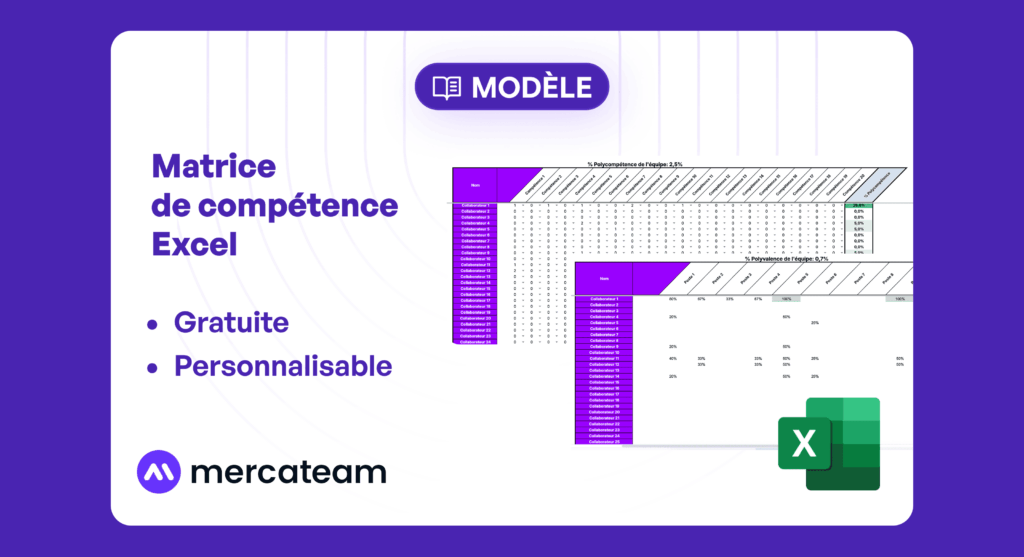
Industry 4.0 is accessible step by step, with simple tools like the skills matrix, versatility chart or digitalized instructions.
Mercateam supports this approach by centralizing skills, authorizations, training and work instructions in a tool designed to accelerate the transition to Factory 4.0.
What is Enterprise 4.0?
A production company 4.0 is an industrial organization that has integrated digital technologies at every level of its value chain.
This can be translated into :
L'automation of certain lines or cells (robots, cobots, real-time control)
The use of sensor data to adjust production, predict breakdowns or trace operations
From connected employeestrained using digital tools (instructions, e-learning, skills matrices, etc.)
More agile, cross-functional governance aligned with performance in the field
It's not necessarily an ultra-robotized factory. Above all, it's an organization more responsive, connected and learning.
Nearly 17 million products are produced each year, with a quality rate of 99,999 %
75 % of processes are automated
The plant is controlled by over 2,800 PLCs on-site products
This plant produces programmable logic controllers (PLCs) - and loops them into its own operations. Siemens illustrates a logic ofintegrated self-generation : its products are used to automate its factory.
The Siemens plant in Amberg is often cited as a model ofIndustry 4.0 quality, traceability and intelligent automation.
2. Bosch: use-driven transformation
Bosch, via its industrial division Bosch Rexrothhas developed an iterative and applied approach:
The company starts with test its technologies in its own plants
It structures its efforts around 4 pillars connected production lines, adaptive production, operator assistance, intelligent product integration
She launched a digital conversion program for its non-graduates, to train them for positions in IT or management
Bosch is more than just a supplier: it's a informed user of its solutions. Our approach is based on experimentation, analysis of feedback from the field, then deployment.
Bosch was also behind the first German national Industry 4.0 training program for technicians.
3. Toyota: automation at the service of people
At Toyota, robotization is not an end in itself: it must be a means to an end. increasing the human factornot replace it.
Mercateam helps you effectively manage skills, training, interviews and instructions in a single tool, designed to speed up your transition to the new market.industry 4.0.
Share
What is Enterprise 4.0?
A 4.0 company is an industrial organization that fully integrates digital technologies, such as automation, IoT, digital twins, real-time dashboards and digital training. It combines performance, agility and innovation.
What lessons can we learn from these companies to ensure a successful 4.0 transformation?
The common keys are :
- Focus on continuous training and employee retraining.
- Developing intelligent automation without neglecting people.
- Centralize skills and authorizations to remain agile.
- Use data and digital twins as performance drivers.
How do you start an Industrie 4.0 approach on your own scale?
Start by mapping your skills via a digital matrix, formalize your work instructions, pilot versatility and adapt your schedules. SaaS solutions like Mercateam support this first key step towards a connected, learning organization.