

With three months to go before an ISO 9001 audit, there is one document you’ll refer to before almost any other: your training matrix. This is where, step by step, you can see proof that the listed skills have indeed been acquired, including who provided the training, what the training covered, the date of the training, and the level at which the skills were assessed.
Instead, many companies present a skills matrix, which leads to a misunderstanding. It explains what a The operator knows how to do it, without showing what What did you do to let him know?, even though the listener is expecting precisely this second piece of evidence.
It all comes down to the details, starting with the structure of the columns, the evaluation system, the signatures, and the expiration dates of authorizations. We’ll walk you through them here, using a food processing plant as an example that you can adapt to your own situation.
Why aren't training matrices and competency matrices the same thing?
In auditing, many companies produce a hybrid document that combines the two tools. This is a fundamental mistake, because Each one answers a different question. The skills matrix It maps out what an operator is capable of doing at a given point in time, position by position and level by level. The training matrix, on the other hand, tracks the history of the training courses each employee has completed: type of course, duration, instructor, date, evaluation, and validity.
One of them answers, « Who can do what? » and is used to plan production. The other person replies, «qWhat was done to teach him how to do it? » and constitutes the evidence the auditor is looking for.".
On the other hand, the two matrices are linked: the competency matrix reveals the gap between requirements and actual skills, while the training matrix records the actions taken to bridge that gap, as required by the Chapter 7.2 of the standard. An assessment on one hand, evidence on the other.
Two tools, two different questions
The two are interrelated: the competency matrix reveals the gap between the required and theachievements, the training matrix records the action that satisfied him. An overview on one hand, evidence on the other.
What does ISO 9001 actually require in terms of training?
The term «training matrix» does not appear in the text of ISO 9001:2015. Your obligations are set forth in Section 7.2, Competence, which applies to anyone whose activities affect the performance of your quality management system—including your operators, temporary workers, and on-site subcontractors.

The four obligations of chapter 7.2
The standard requires you to do four things in sequence
- determine the skills required for each position
- make sure that the people in those positions have them
- take action to bridge the gaps
- and then evaluate the effectiveness of this action.
Fourth is the one we’re least good at filling out. We often keep a partial skills profile you've acquired, thinking you've done what's necessary, when in fact your training matrix is intended precisely to compile this evidence into a single, easily accessible document.
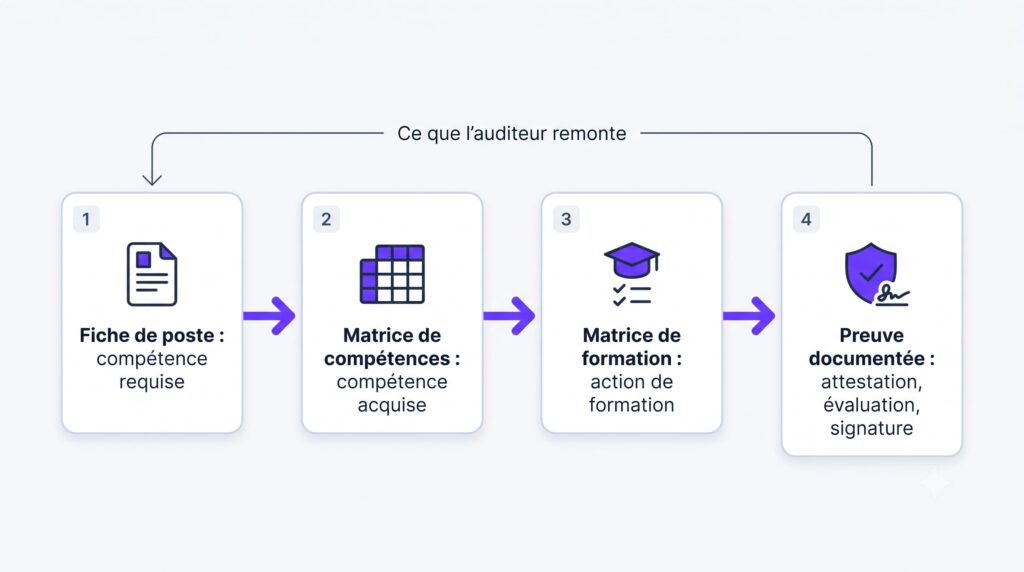
The auditor, for his part, verifies that they are up to date, dated, and signed when required, and that the logical chain holds up— from the job description that lists a competency to the competency matrix that confirms it has been acquired, all the way to the training matrix that shows the training that enabled it.
It is this chain that he traces back, link by link, and a single missing link is enough to create a gap.
What the standard refers to as «documented information»
Chapter 7.5 defines documented information as any information that the organization must manage and keep up to date. As for the lineup, here is the list:
- attendance records
- certificates of completion
- Hot and Cold Evaluation Forms
- job interview records
- tutorial sheets signed by the tutor and the operator
- certificates of authorization
- results of the on-the-job practical evaluation.
The fact that no specific format is required can sometimes be misleading. Paper, Excel, and software are all acceptable, provided that your records remain immediately accessible and traceable, and that you can demonstrate that they are updated regularly.
It’s often this immediate access that becomes a challenge in Excel after two or three years, when there are multiple versions and a scanned certificate ends up in a network subfolder that’s hard to find. Preparing for the audit then wastes valuable time.
Organizational Knowledge and Information Management
Chapter 7.1.6, on organizational knowledge, accounts for nearly 30 % of the nonconformities identified during ISO 9001 audits according to certification bodies. The standard views collective expertise as an asset to be protected. A well-maintained training matrix contributes directly to this: it keeps track of the skills that have been passed on and flags the imminent departure of key personnel before that knowledge leaves with the individual.
Chapter 7.5 adds document management. Versions of the materials have been identified, changes tracked, and old versions taken out of circulation. Train an operator in 2026 using a 2019 instruction sheet that’s still in use, and the discrepancy will surface that very morning.
The Structure of a Compliant Training Matrix
A matrix that can be used for auditing is based on three inseparable components: the columns that describe each action, the evaluation system that verifies completion, and the versioning mechanism that ensures traceability over time. Remove any one of them, and the evidential value collapses.
Required columns for the audit
Each row corresponds to a training course taken by an employee. The minimum columns to include are:
- Employee ID and name, position, and department
- Exact title of the training course and internal reference code
- Type of training (in-house, external, AFEST, mentoring, e-learning)
- Name and Qualifications of the Instructor or Tutor
- Date of Completion and Actual Duration
- Assessment method used (multiple-choice questions, role-playing exercises, on-the-job observation)
- Score Achieved and Passing Score
- Expiration date or next renewal date when the action relates to an authorization
- Reference number of the supporting document (statement, certificate, signed form)
The version of the medium used resolves nonconformity 7.5 when you train using a revised document; the manager's approval locks the signature chain before it is forwarded to the quality department.
If you had to secure only one of them before an audit, that would be the expiration date : It's the one that causes the most certifications to be revoked, far ahead of the rest.
The Assessment System (Levels and Criteria)
The standard requires that training be effective, not just that it be conducted. Since the 2015 version, a certificate of attendance is no longer sufficient. The evaluation is based on four levels.
- The first measures trainee satisfaction immediately after the session.
- The second one assesses knowledge acquisition through a test or a multiple-choice quiz.
- The third, the one the listener is looking for, involves assessing the transfer of skills in the field through on-the-job observation or a supervised practical exercise.
- The fourth, which is less common, measures the impact on service performance or the reduction in product nonconformities.
For a production operator, a credible competency matrix must include at least Levels 2 and 3. The multiple-choice quiz verifies theoretical knowledge, while the practical evaluation confirms on-the-job performance. In our experience, at the sites we support, virtually all discrepancies in this area stem from a lack of Level 3 training, not from a lack of theoretical knowledge: training was provided, the multiple-choice quiz was administered, but no one went to the workstation to verify that the skills had been mastered. Without this Level 3, the auditor will conclude that you provided training without knowing whether the training was effective.
Versioning, Signing, and Traceability
A paper binder or an Excel file is only valuable if it follows a clear update protocol: who makes the changes, when, and why. Without it, the matrix ceases to be evidence. In a manual system, this requires a «date updated» column, a signature for each significant change, and a separate archive of previous versions.
In my experience, signing off on field assessments remains the most challenging part.
The auditor expects to see a record with the name of the trainer or mentor who validated the learning outcome, so in Excel you end up scanning signed sheets that are filed elsewhere, which makes it difficult to access the information immediately on the day of the audit.
Example of a training matrix in a food processing plant
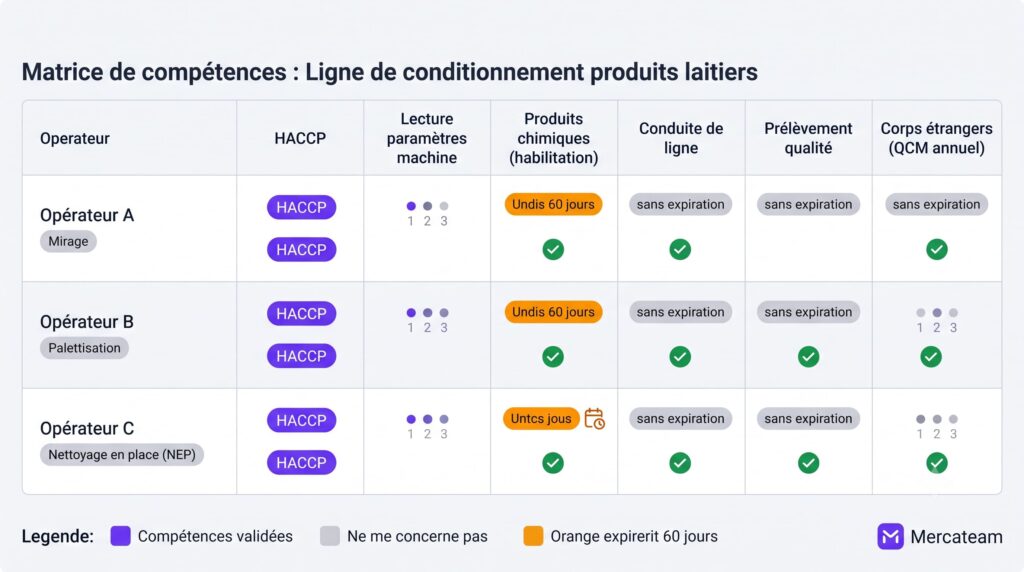
Let's take a dairy packaging line as an example. Three operators rotate through the inspection, palletizing, and cleaning-in-place stations. Each station requires distinct skills: HACCP guidelines, reading machine parameters, chemical cleaning procedure, quality sampling protocol.
Over a 12-month period, the production schedule for this line includes about 20 lines per operator. The HACCP framework is common to all, and then the modules are tailored to each workstation:
- Chemical training with a three-year certification
- Line operation with a practical evaluation signed by the team leader
- Awareness training on foreign bodies, including a mandatory annual multiple-choice quiz.
Many workshops start with an Excel skills matrix template to structure these rows, only to run into its limitations.
A well-designed matrix separates the actions that are about to expire (the authorizations) actions with no expiration date (one-time notifications), and highlights in orange those due within 60 days. This visual heads-up prevents the scenario that every quality manager is familiar with: an operator working with an expired authorization on the morning of the audit, without anyone having seen it coming.
[Image, screenshot : shows an actual training matrix for the described packaging line, to make the example more concrete. Image prompt: screenshot of an agri-food training matrix table, with columns for operator, workstation (sorting, palletizing, cleaning), training, certification with expiration date, signed practical evaluation, several deadlines highlighted in orange with less than 60 days remaining, a clean and professional software interface without competing brand logos, high definition.]
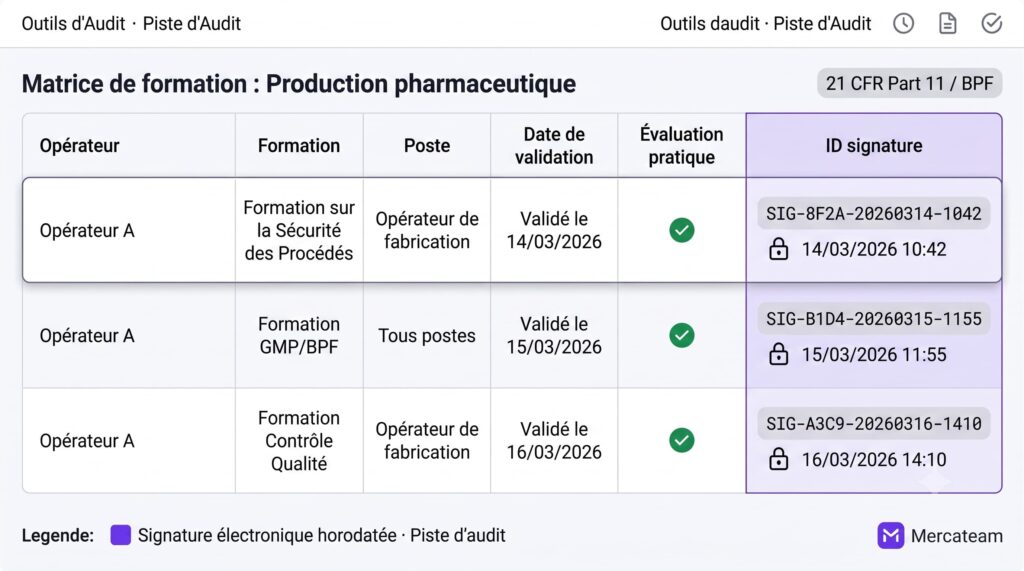
In the pharmaceutical industry, the logic is the same, with the added requirement of an electronic signature, which must comply with GMP (21 CFR Part 11 for exports to the United States). The matrix then adds a «Signature ID» column» which links to the timestamped record of each validation.
What the auditor is actually checking
The listener does not read the matrix line by line. He uses sampling : He selects two or three employees—often those who have been with the company for less than three months or those in critical roles—and goes through the entire process. Job description, required skills, tracked activities, evaluation records, and current status.
The most common gaps in skills management are:
- No post-training assessment (Level 3) for on-the-job training
- Undetected expired authorizations, with operators still working in the relevant activity
- Outdated versions of training materials that are still in use internally
- Contractors or temporary workers who are not included in the matrix even though they work in critical positions
- Missing signatures from tutors or managers on practical evaluations
- No record of any action taken to address a competency gap identified the previous year
This last point is the clearest sign that the system isn't working properly.
The auditor compares the matrix for year N with that for year N-1 and tracks down any discrepancies that were identified but never addressed. A reported deficiency that is still present twelve months later indicates a quality system that fails to close the loop. This is precisely where long-term training follow-up proves its value, far beyond the snapshot taken during the audit.
The 6 Discrepancies That Lead to Loss of Certification
There is no record of any action taken to address a gap in competence identified the previous year. A reported shortcoming that remains unresolved twelve months later indicates that the quality system is not closing the loop. This is the first sign that the system is not functioning properly.
At Mercateam, we equip more than 300 industrial sites, and the same issues keep cropping up workshop after workshop. Who has the latest version of the file? Who made what changes last month? Where can we find the scanned certificate for an operator who was trained two years ago? How do you notify the manager 30 days before a certification expires, without having to remember to do it yourself? None of these questions has a reliable answer in a shared spreadsheet.
Switch from Excel to a controlled matrix
A single source for all your matrices, automatic expiration alerts, a time-stamped history, and an audit report generated in two minutes instead of half a day of compilation.
Book a demoPrepare for the audit using an up-to-date matrix
An ISO 9001-compliant training matrix is more than just a document produced to reassure an auditor. It is the tool that proves your quality system is fulfilling its commitments across the entire chain of competencies, training, and evidence. When properly maintained, it serves you all year round: planning renewals, identifying priority training candidates, and approaching the audit without undue stress.
On the big day, you set a Up-to-date, traceable matrix with signatures and field evaluations. The auditor performs sampling, traces the supply chain, and finds no discrepancies. Certification is granted for three years.
To see what an industrial matrix managed by training management software looks like, request a demo and compare it to a scenario similar to your own.
Review our matrix about a case similar to yours
Explore a software-driven industrial matrix that maps to your job positions and critical authorizations. Let’s work our way up the chain together, from the job description all the way to the supporting documentation.
Book a demo